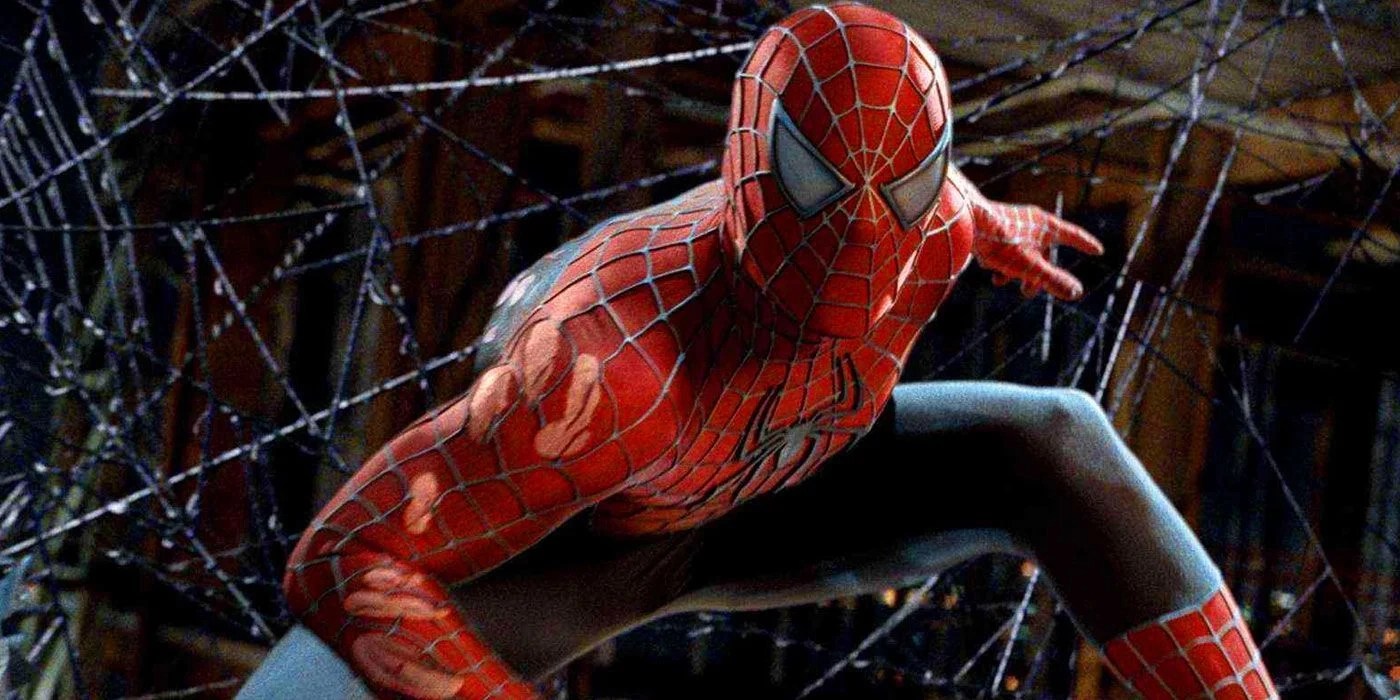
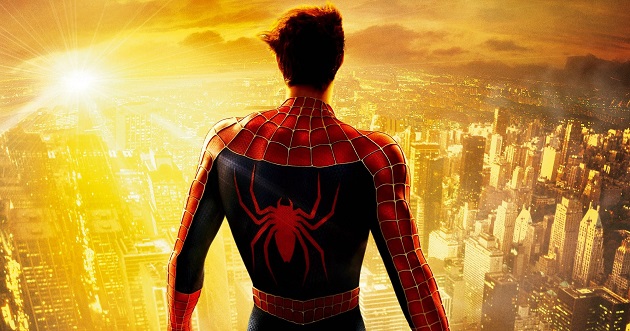
It’s a testament to Willem Dafoe’s terrific performance as Spider-Man‘s Green Goblin that I was too afraid to watch the 2002 film as a child. My dad wasted money on tickets to see it in the theater; I started crying the moment we entered and heard Dafoe’s booming cackle. Once the movie saw a home video release, a kid at my daycare pining for clout brought the VHS to break up our afternoon monotony of movies like Chitty Chitty Bang Bang and The Sound of Music. As the opening credits rolled on the small CRT TV, I began hyperventilating and fell into a full-blown panic attack. The daycare called my mom to pick me up, and the embarrassing experience pushed me to ask my mom to buy the movie for our new DVD player at home. Through sheer seven-year-old willpower, I made it through a viewing of Sam Raimi’s Spider-Man on our living room’s big screen. I fell in love with the dazzling special effects, the epic yet campy tone, the thematic resonance of Peter Parker’s two hour journey. Spider-Man became my lifelong favorite superhero.
Then Spider-Man 2 was better in every way. It’s been my favorite movie since I opened it as a Christmas gift from my dad, and watching it last month proved it holds up. It exemplifies the perfect sequel, scoffs at the idea that the second movie is always worse than the first. The themes and threads presented in Spider-Man are all revisited and further expanded on. Audiences are treated to the most human Peter Parker to appear on screen to date. The film explores the dichotomy between selfless Spider-Man and the man under the mask who just wants to catch a break. Doctor Octavius is an excellent antagonist who personifies Peter’s personal fears, a man whose ambition takes everything from him. Peter witnesses firsthand the danger that comes to the loved ones of powerful people, and he sees how that love lost can turn man to monster. While each Spider-Man features a fine-tuned narrative, the second movie best demonstrates this trilogy’s ability to tell an enthralling story with each element moving together like parts in an efficient machine.
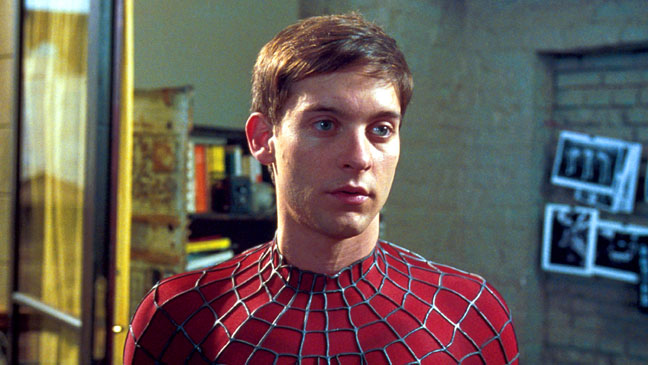
My love for Raimi’s Spider-Man trilogy drove me to comics, and I found in the colorful pages the same things that made me love Tobey Maguire’s Peter. The endless struggle between selfish desire and doing the right thing, the everyman always slightly behind ends meet, the evolving definition of what it means to be a hero. Maguire’s Peter still stands unique in comparison to later film-interpretations of the character. Marc Webb portrays Andrew Garfield’s Peter as an edgy skater who is in no way uncool. Jon Watts leads Tom Holland’s performance as an aw-shucks shy teenager who dresses well and gives the impression of a preppy kid making himself appear nerdy in the name of hipster chic.
Meanwhile, Maguire and Raimi craft a Peter who is similar to the intelligent outcast from Stan Lee’s immortal 1960’s Amazing Spider-Man run. Peter here has cringe one-liners in his bouts with supervillains that both work for Raimi’s auteur directing style and for Maguire’s interpretation of the character. His awkward earnestness when talking to Kirsten Dunst’s Mary Jane, his star-crossed love interest, is both painfully believable and endearing. Maguire’s performance has been eternalized by memes stemming from Peter’s comedically dark turn in Spider-Man 3, but the character always had that edge. Each film follows a distinct arc revolving around one of Peter’s major flaws, and his journey to overcome his own issues is often more interesting than the big climactic battle with his antagonist.
Spider-Man shows Peter struggling with the responsibility of being a hero, and he develops an initial grasp of the sacrifice necessary to live a life as the wallcrawler. In Spider-Man 2, Peter fights to find a balance within his dual life. The themes of personal sacrifice are further expanded, and he learns through his interpersonal plight the importance of remaining steadfast and responsible—even at the cost of the romance with Mary Jane he wishes for more than anything. Finally, in the massive Spider-Man 3, Peter conclusively faces the inner arrogance that directly led to his uncle’s death at the beginning of his journey. While many lament the goofy direction this inner turmoil takes, it fits perfectly within Raimi’s directorial style established in his earlier works like The Evil Dead.
Another holdover from Raimi’s early career directing horror is the underlying scary mood present in each movie. Each film features moments of body horror: Peter’s ability to crawl walls is visualized through microscopic spikes jutting from his fingertips, and his body produces organic web fluid—a jarring change from the hand-made technological web shooters present in the comics. The villains all have horrific origins, brought to life by a series of excellent performances from the likes of Willem Dafoe, Alfred Molina, and Thomas Hayden Church. Dafoe’s Norman Osborn has a grisly transformation into the Green Goblin, his alter ego. His portrayal of the long-standing comic character is more reminiscent of classic horror villains than the antagonists present in modern MCU films. Molina’s Otto Octavius boasts the most horrific scene in the series: he memorably massacres a team of surgeons in a scene that harkens back to Raimi’s Evil Dead films. The demonic possession rampant in that trilogy is also present here, in a sense. Osborn, Octavius, and Spider-Man 3‘s Venom are all at the mercy of some out-of-body force. For Osborn, experiments with a weapons-grade gas creates a new maniacal persona; Octavius is controlled by rogue artificial intelligence he created; and Topher Grace’s Eddie Brock is possessed by an alien symbiote that embellishes his worst character traits, transitioning him into a dark mirror of Spider-Man.
Despite Venom’s late inclusion in Spider-Man 3 being critically scoffed over, he does have a thematically relevant role to play. He physically represents the dark side of Peter the audience has watched for the preceding hours of film, although the character had enough unexplored rich potential that he would have been better served in his own sequel film. Despite an infamous case of studio interference, Spider-Man 3 does manage to host a great villain in the Sandman. His origin being tied directly to Peter has been discussed as a contentious choice for the last decade, but it helps to fully realize Peter’s complete arc across the trilogy. Despite Peter’s character growth over the first two films, the only person he has been unable to forgive for his years as Spider-Man is himself. While an obvious retcon, Sandman being his uncle’s true killer works narratively in a similar way to Venom. While Peter symbolically views himself as responsible for his uncle’s death, he faces off with the man who actually pulled the trigger. The depth of this dynamic should have been the bulk of the movie.

What makes Raimi’s Spider-Man stories memorable, even after two more separate Sony-led Spider-Man series, is the parallelism present between Peter’s personal flaws and the downfall of each film’s main antagonist. Raimi’s films easily draw connections between Peter and his villains, a feature not prevalent in either Garfield’s or Holland’s appearances. The main enemies in The Amazing Spider-Man are all directly created by Garfield’s Peter’s actions. He gives his first major villain the mathematical equation that turns him into a monstrous lizard; his ego and dismissal of a nerdy Jaime Foxx leads to the creation of the evil Electro; and the same venom that created Spider-Man turns Dane Dehaan into a Green Goblin. Holland’s villains both hold grudges against the MCU’s Tony Stark, Peter’s mentor in those films. Peter is indirectly wrapped up in their revenge plots against Stark, and he bumbles his way to victory against them both. There is little narrative correlation between the MCU’s Spider-Man and his central antagonists.
The villains of the Spider-Man trilogy are not its only great supporting characters. Although spawning some jokes over the years, Dunst’s performance as Mary Jane is consistently solid. Although she and Maguire may not share quite the same chemistry as Andrew Garfield and Emma Stone in The Amazing Spider-Man, their relationship is incriticate and personal. The bond Peter and Mary Jane share is the backbone of Raimi’s trilogy, and it is equal parts satisfying and fulfilling that the final movie ends with a somber, romantic dance they share in a jazz bar. Raimi’s final scene is a huge contrast to the impressive web-swinging crescendos the first two films end with, but there was no better way for these characters to go out. Peter’s friendship with James Franco’s Harry Osborn is established well enough in the first movie to work as an emotional throughline for the sequels. Its conclusive execution in Spider-Man 3 isn’t as deftly handled as other storylines, but their alliance in the final battle is satisfying and a worthy send-off for Harry.
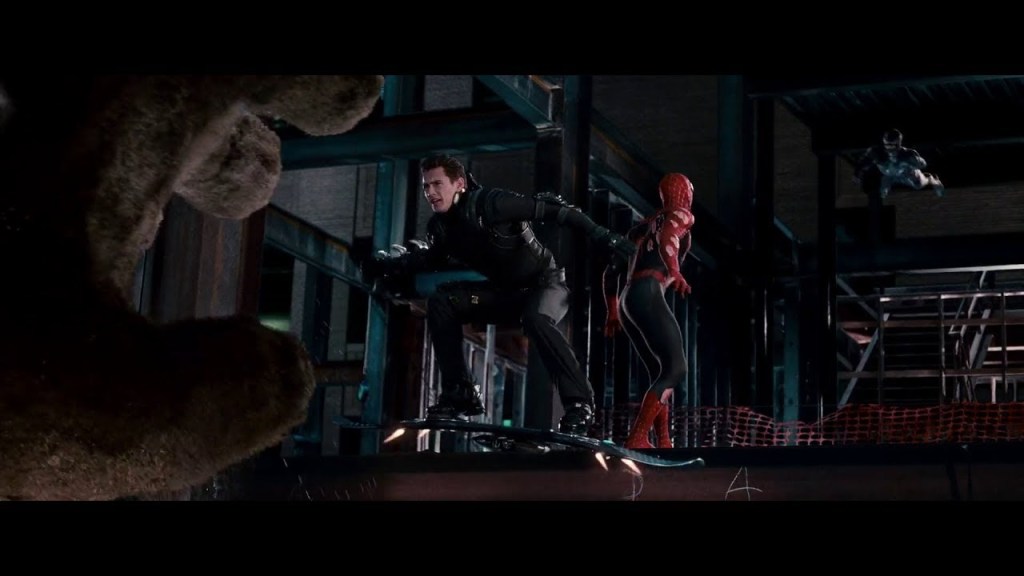
Rosemary Harris stands out as May, Peter’s moral compass. She has some of the best lines of dialogue in the series, and Raimi trusts her with key scenes that address each of Peter’s thematic struggles. And of course, J.K. Simmons’ larger-than-life performance as newspaper mogul J. Jonah Jameson is such a raging success that the character hasn’t been recast across three different Spider-Man franchises. His unforgettable portrayal made the character more popular than ever before and demonstrates that excellent acting can be found even in the depths of the often dismissed superhero genre.
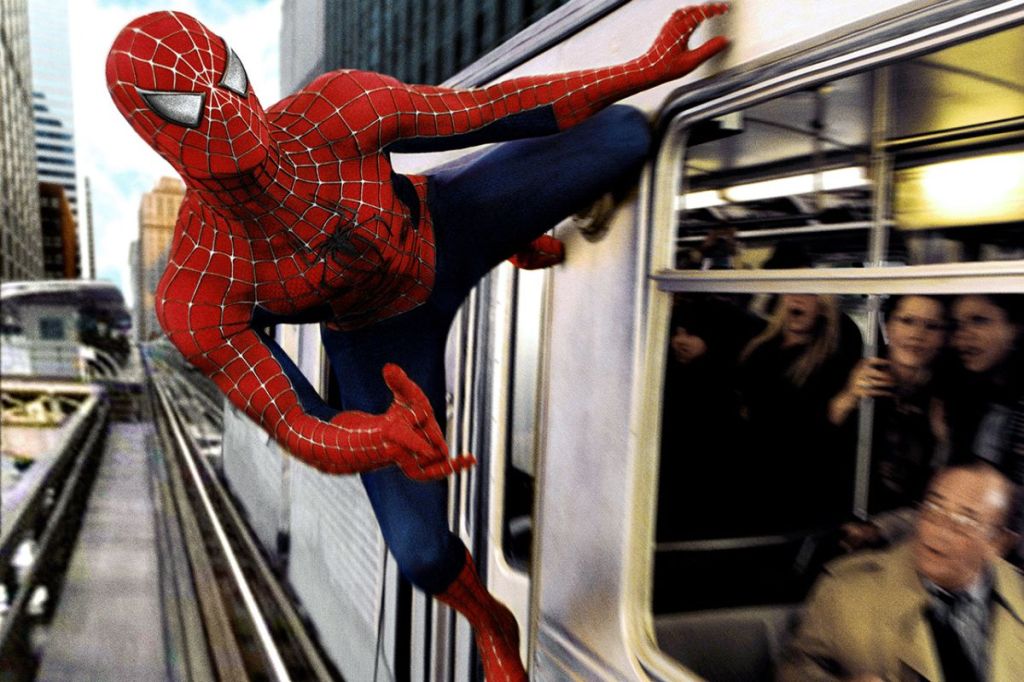
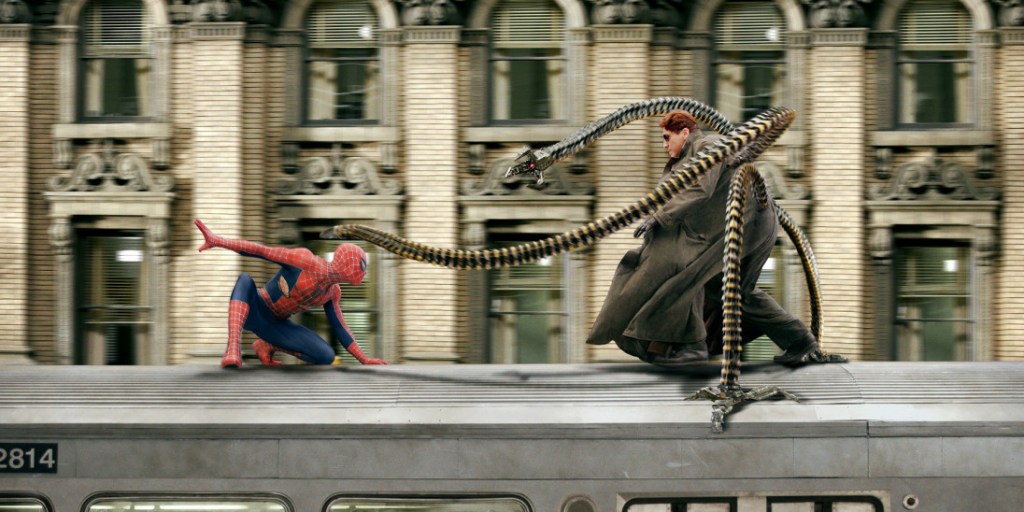
The production quality of the film is Hollywood’s early-2000s state-of-the-art. Its CGI effects have definitely aged, but they stunned audiences at the time and often hold up compared to even modern superhero films. It’s too soon to tell, but the 2004 CGI used for the superhuman movement of Molina’s Octavius in Spider-Man 2 seems more effective than the 2021 CGI used on the same actor playing the same character in promotional material for the upcoming Spider-Man: No Way Home. There are glaring moments of CGI that are frankly distracting by modern standards, including Peter’s pursuit of the criminal he believes shot Uncle Ben in Spider-Man and his airborne battle with Harry early in Spider-Man 3. The special effects are still impressive in more cases than not, particularly in most of the series’s astounding fight scenes. The best of these instances is Spider-Man 2‘s subway duel, and Raimi’s team blends computer graphics and practical effects to make one of the most unforgettable scenes in film history.
The myriad of camerawork across the trilogy is a filmmaking triumph. From the special camera invented for the web-swinging sequences to the standout direction in scenes like Spider-Man 2’s surgery massacre, Raimi proves time and again his mastery of his craft. The original Spider-Man trilogy oozes with Raimi’s auteur style to this day, and stood out against its peers even back in the early 2000s. That’s not to say the films aren’t products of their time; each movie features tie-in theme songs from some of the biggest bands of the era—Nickelback, Dashboard Confessional, Snow Patrol. These rock songs don’t hold a candle to the soaring orchestral score by Danny Elfman, and the main theme remains one of the best movie compositions of all time. Elfman’s music makes the action on screen feel truly heroic, and Peter’s struggles are raised to a mythological scale.
It would be easy to go on for hours about any of Raimi’s Spider-Man movies. Even the worst of the trilogy is rich with thematic resonance and deliberate direction. Spider-Man helped kick off the biggest movie genre in history, and that accomplishment is easily understood upon watching the films today. With Sony’s upcoming No Way Home set to feature many of the Raimi characters, it’s clear that Spider-Man is still one of the greatest and most influential movie series of all time.
 Red Comet Reviews
After watching no way home, I’ve gotta agree that spider-man is indeed the best superhero. I don’t remember much of the older movies since I watched them so long ago, but whenever I think back to them I always feel a sense of joy. Truly a great franchise.
LikeLike