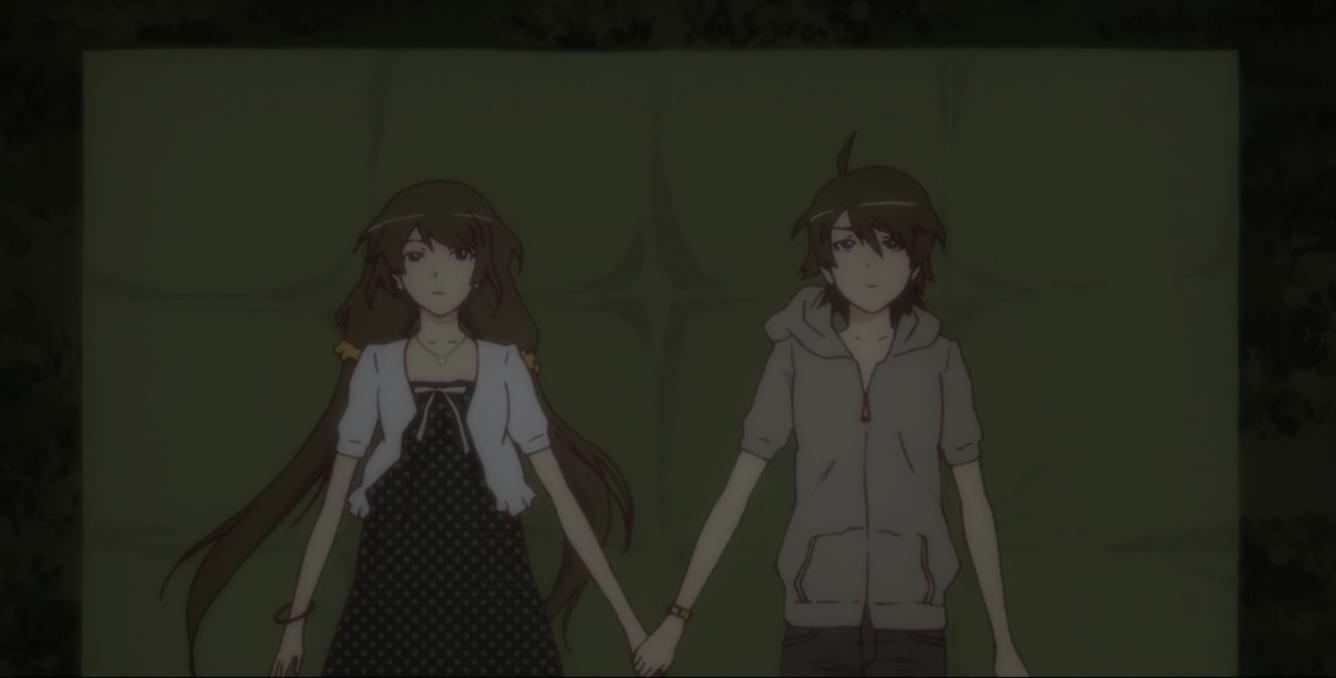
There are two schools of thought when considering rewatching a piece of media. One is a more pessimistic prediction: experiencing something one loved when much younger may result in someone becoming aware of severe flaws in the work, a feeling that the piece is not actually as powerful as they once thought it was. But I find that the other perspective is more often true: revisiting an important book, game, or movie can result in a far deeper appreciation for the piece. When one has already consumed a story and takes time away, they can return to an old favorite with a far more vast life experience, a more nuanced understanding of storytelling. A truly great work of art allows for each rewatch, reread, or replay to provide an enriching experience different from those that have come before.
The Monogatari franchise is one particular work I have avoided going back to over the years. As a child, Dragon Ball and Naruto were formative pieces of media for me, influencing my taste in longform stories for years to come. However, despite my borderline obsession with both of these, anime as a medium did not appeal to me much. I was more drawn to western works, whether binge-reading Marvel comics online or engaging with a variety of fantasy novels and video games. My best friends at the time experimented with the other anime airing on Cartoon Network’s Toonami and Adult Swim programming blocks, including series I would later grow to love like Cowboy Bebop and Ghost in the Shell: Stand Alone Complex. Despite their encouragement, my adolescent experience with anime began and ended with only the most popular battle shounen series.
In my early college years, I was often too busy with schoolwork and socializing to engage with the hobbies that had kept me alive through my teenage years. I stopped reading books, limited my hours playing video games, and only watched the biggest television shows to keep up with the conversations of my classmates. However, I was hit with a serious stomach illness halfway through my third year, resulting in me being unable to leave my house for more than a few hours at a time. This lasted over the course of several months. To stave off boredom and melancholy, I allowed some close friends to convince me to watch that era’s most popular anime, shows like Sword Art Online. While not the deepest emotional experience, simple series like that helped to reignite my interest in the medium. After completing a few dozen series, a few of my childhood friends conferred with one another to determine if they thought I was now prepared for “real anime,” something that would truly recapture my youthful love of the artform. “Real anime,” to them at least, was Monogatari.
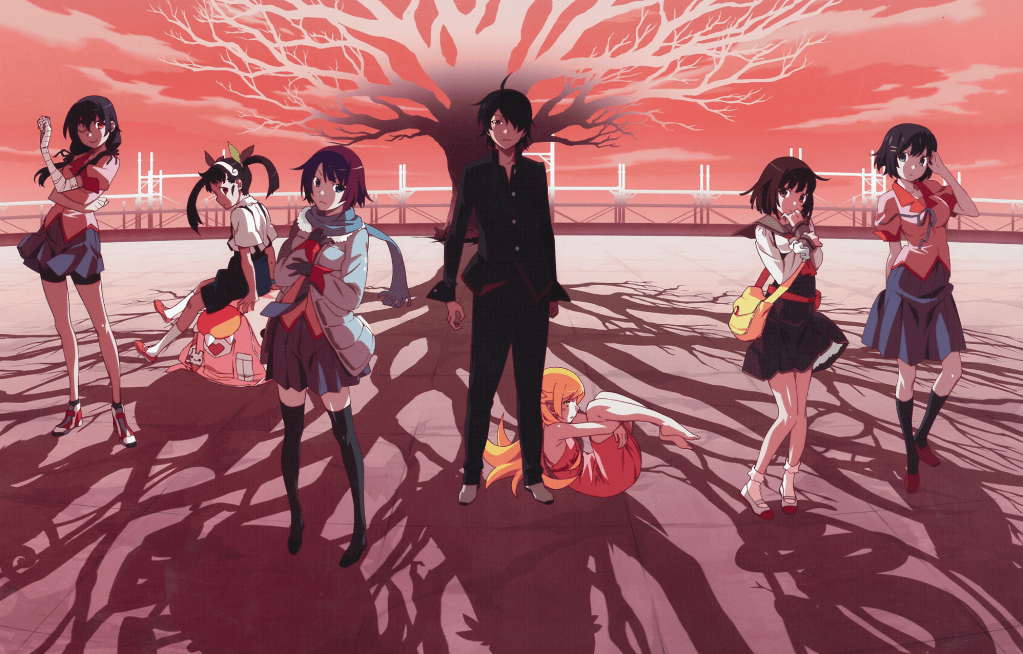
Gatekeeping snobbery aside, I immediately understood what they meant. In short, Monogatari follows high school senior Koyomi Araragi as he helps out various characters with supernatural afflictions. These problematic entities and curses are referred to as “oddities” or “apparitions,” depending on the translation. Each individual arc in Monogatari is named after its central character, usually the victim of a malignant spirit or curse, and whatever their given affliction might be. By the end of the first of these, “Hitagi Crab,” I knew I was watching one of those special pieces of media that would ultimately affect how I experience and think about stories as a whole. My first viewing of Monogatari changed me for the better. To this day, it remains one of my favorite stories of all time, regardless of medium. Though I knew what I was watching was special, I didn’t have the experience or vocabulary to express why exactly it moved me. Upon revisiting it, I hope the better part of the last decade has helped me find the words to do that.
Despite my love for the franchise, I avoided returning to older entries for the next decade. Monogatari features many hallmarks of anime that actively impact my enjoyment of the medium, including fan service and depicting its female characters in compromising situations for no apparent reason other than the enjoyment of its audience. I understand there is a wide audience for these tropes in anime, but they have always been lost on me in particular. While I could easily look past these elements ten years ago, I worried that rewatching it would ultimately sour my fond feelings toward the series. Fortunately, the severity of the more problematic parts of Monogatari was simply enhanced by time and memory. Upon finally rewatching Bakemonogatari, I discovered that there was actually very little “fan service,” that these moments I thought I remembered were few and far between. When it does occur, there is a deliberate nature to its inclusion, for better or worse. And this actually becomes part of one of the more interesting aspects of the series.
Monogatari‘s greatest strength is in its characters. The episodic stories are firmly rooted in the perspective of a given entry’s protagonist. Although most of these tales follow one recurring protagonist, there are several notable arcs led by other characters. Each character has a personalized point of view, and a variety of narrative and production techniques are utilized to essentially allow viewers to see through the eyes of an entry’s respective protagonist. The characters in Monogatari are unique and compelling across the board, though Bakemonogatari specifically highlights two of the franchise’s most dynamic: Koyomi Araragi and Hitagi Senjougahara. More importantly, the series depicts and arguably revolves around their developing relationship, one that is intricate, complex, and realistic. Applying a strict genre to Bakemonogatari is difficult; however, I would argue that it is most clearly a romance, and one of the finest in the genre at that. The romance at its center requires both parties to overcome inherent character flaws and grow both individually and together. By the end of the series’s 15 episodes, viewers have witnessed the intricate development of a relationship that feels true, a bond between fictional characters from which we can learn something in reality about personal progress, being human, and how to love.
Koyomi Araragi
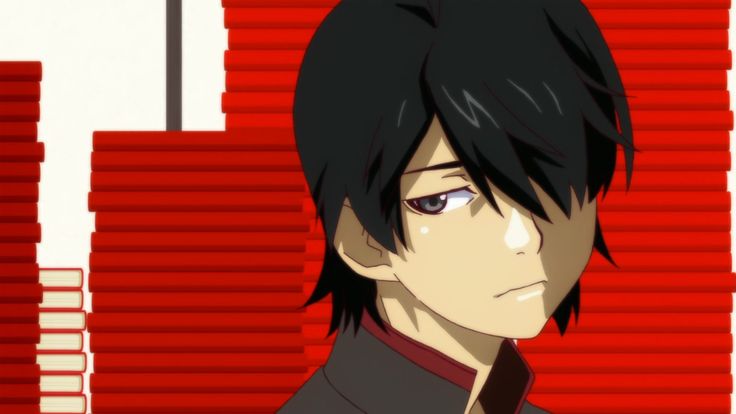
The events of Bakemonogatari‘s five arcs in particular are presented through the subjective lens of Koyomi Araragi. He is a teenage boy, and despite his protests to the contrary, he is easily prone to perverse fantasies. The series is adapted from a series of Japanese novels written by Nisio Isin, most of which are narrated from Araragi’s first person perspective. Within Isin’s prose, Araragi’s narrative voice is distinct and effortlessly emulates the mentality of a teenage boy, one on the precipice of high school graduation and facing the series of great changes that separate children from adults. Araragi’s strong characterization is paramount to the success of Monogatari, which presented the production team with a large challenge from the start. They needed to make unique creative decisions utilizing the medium of animation, choices that could capture a similar effect for a viewing audience that a reader may experience through one of the original novels. In the anime, Araragi’s adolescent perspective is portrayed through careful camera work and stunning direction, granting Monogatari a certain artistry that the grand majority of anime simply lack. His inner thoughts are frequently displayed as text from the original light novel series flashing on the screen in a splash of color, too quick for anyone to actually read—unless they are actively pausing on each frame to read the individual lines. While Bakemonogatari features many beautiful establishing shots and brilliant tableaus of characters spending time together, many of its shots are close-ups of whoever Araragi is speaking to. There is often a deliberate effect of gazing through Araragi’s eyes at the subject of his focus. Araragi is also likely an unreliable narrator: there are notable moments where characters behave in a forward, affectionate way toward him, but a quick cut, almost like blinking, results in the character appearing farther away, acting normally at a more formal distance. The viewer sees Araragi’s pubescent fantasies bleed into his reality, so it can be intentionally difficult to siphon truth from fancy. This directorial tactic is made more obvious by later Monogatari entries that focus on other characters and resultantly lack Araragi’s daydreamy filter over the events depicted.
By the time Bakemonogatari begins, Araragi has had two major encounters with the supernatural. The first of these was a horrific clash with the legendary vampire Kiss-Shot Acerola-Orion Heart-Under-Blade, an event later depicted in the Kizumonogatari film trilogy. Araragi’s encounter with the vampire, who is later referred to as “Shinobu,” left him with supernatural abilities. He is approximately “one-tenth vampire” according to Meme Oshino, his mentor in all things apparition. This mostly means Araragi is able to rapidly recover from what should be lethal injuries, although there are instances where he demonstrates superhuman strength and speed. He becomes more powerful for short periods of time by borrowing power from Shinobu—her battle with Araragi left her trapped in the form of a small child, and she lives with Oshino in the abandoned cram school that serves as his base of operations.
Araragi’s other supernatural encounter involved Tsubasa Hanekawa, his friend and classmate. Despite Hanekawa’s excellent grades, her parents subject her to verbal and physical abuse. One day while walking with Araragi, Hanekawa discovers and subsequently buries a dead cat. As an unfortunate result of her noble deed, each night she is possessed by an otherworldly entity, one that acts on Hanekawa’s hidden impulses. Though she is usually mild-mannered and reserved, the possessed Hanekawa behaves in a way that is playful and sexually vulgar. She also drains the energy of others, leaving victims in a state close to death. Araragi enlists Oshino to help him stop Hanekawa, and together they manage to subdue the girl and lock away the mischievous spirit—though this also seals away Hanekawa’s memories of the incident.

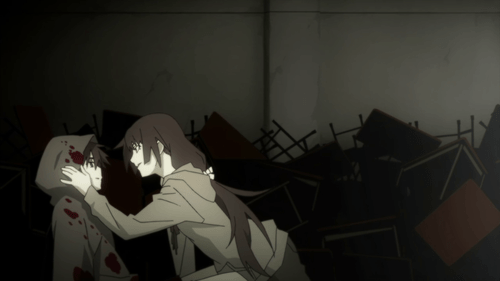
While only alluded to in Bakemonogatari, which was the first entry released in the franchise, both incidents are key to establishing and understanding Araragi’s character. He falls into the world of apparitions out of an earnest desire to help others at any potential cost to himself. He initially discovers Shinobu as an adult vampire abandoned in a subway station, rendered limbless and left for dead. Despite his horror at her nightmarish nature, he allows her to drink his blood, understanding the sacrificial act would result in his death. When he later wakes up as a vampire, he agrees to help Shinobu recover her limbs and return to full strength. After a series of violent events depicted in Kizumonogatari, Shinobu and Araragi are reduced to the forms viewers first encounter in Bakemonogatari: a small child and weak part-vampire, respectively. Though carrying lower stakes, Araragi’s rescue of Hanekawa reflects his consistent desire to help those in need. Though Hanekawa’s catlike alter ego is much more physically formidable, Araragi’s resolve to save his friend ultimately wins out.
Araragi’s motivation to rescue others at any cost stems from two factors. The first of these is his upbringing: both of his parents are police officers, and they have instilled a strong sense of justice in all three of their children. Future entries explore the Araragi sisters Karen and Tsukihi, demonstrating their similar values. All three siblings share a desire to help their friends and strangers alike, and they approach dilemmas with a sense of grace and fairness. Araragi’s other underlying drive is an utter lack of care about himself. Throughout the series, he is shown to be prone to excessive guilt and self-doubt, willing to throw his own life away at a moment’s notice if doing so will solve the problems of others. He moves passively through his life, showing very little effort in school, very little concern for his future.
Araragi has a warped philosophy regarding human relationships. He views them as weaknesses, believes that emotional strength stems from self-imposed isolation. In the light novel Kizumonogatari, Araragi expresses this school of thought to a friend: “If I had friends, I’d have to start worrying about them, right? If my friends were hurt, I’d feel hurt too, and if they felt sad, I’d feel sad too. You end up with more weak points, so to speak. I think that’s the same as becoming weaker as a person.” In other words, Araragi refuses human connection so that he will remain emotionally undamaged, afraid of the potential hurt that comes from relationships with others. By the time Bakemonogatari begins, he only has three notable relationships. One of these is his close friendship with Hanekawa, forged due to her persistence in growing close to him. The other two are with Meme Oshino and Shinobu, though even those are relatively distant: he seeks Oshino’s advice when encountering new apparitions, and he allows Shinobu to slowly recover her strength by drinking his blood. Oshino repeatedly suggests Araragi should abandon Shinobu and let her die; after all, if he stops letting her feed on him, Araragi will eventually lose his partial vampirism and become human again. However, Araragi feels immense guilt and responsibility for her weakened state, so he remains resolute that he will help her stay alive.

Toward the end of both the “Suruga Monkey” and “Nadeko Snake” arcs, Araragi offers his life to the apparitions plaguing the titular girls. In the latter arc, Araragi pries a curse, represented by an invisible demonic snake, from Nadeko, saving her from a brutal suffocation. As the snake targets him, Araragi almost goes as far as to allow the snake curse to kill him, as avoiding it would cause it to return to those who initially conjured it with malicious intent, two strangers who wished only to harm Nadeko. He is stopped by Suruga Kanbaru, his friend and underclassman that he saved in the previous arc. “Please don’t choose the wrong person to save,” she says between labored breaths. Still, after he fails to stop the serpent and Nadeko thanks him with earnest gratitude, Araragi feels nothing but self-loathing toward his inherent compulsion to save everyone. Internally, he begs Nadeko’s forgiveness for, in his view, being so pathetic as to attempt to give his life to save the very people who almost killed her.
Hitagi Crab
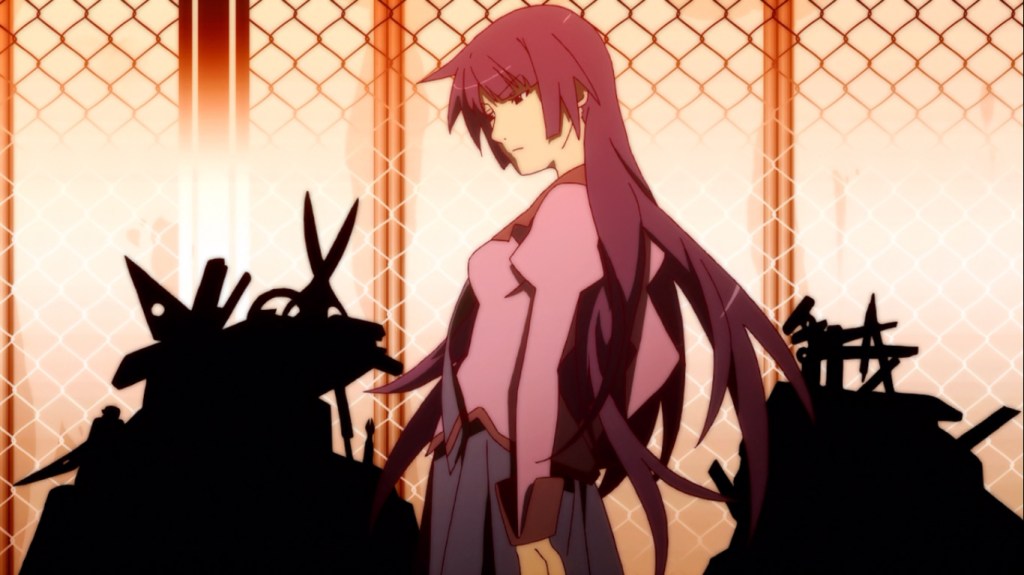
Despite Araragi’s conflicted feelings toward his own heroic nature, it is this very tendency to help others that leads him to meet Hitagi Senjougahara, arguably the central heroine of Bakemonogatari, in the series’s opening moments. After contextless flashes of previous action, namely Araragi’s spring break battle with Shinobu, viewers first encounter Araragi sprinting up a mountain of stairs within Naoetsu Private High School. In the first of many glimpses at Araragi’s inner thoughts, he reveals his tardiness, his tendency to be late to class. The school’s stairwell is depicted as a colossal spiral hugging the interior walls of a massive glass tower, likely one of the earliest signs of Araragi’s subjective perspective impacting the presentation of settings and events. Much higher up, viewers see Hitagi Senjougahara, a model student in Araragi’s class. Due to an odd frailty and a twist of fate, she falls from her great height, dropping down the open center of the tall tower. Witnessing her descent, Araragi drops his bag and holds out his arms, catching her and saving her life. Even in the face of this heroic act, he shrugs off his own valor: it was a “better decision than dodging,” he thinks, dismissive of his own inherent goodness. Though his vampiric strength would have aided in the otherwise impossible rescue, Araragi immediately notices something amiss with his classmate; she weighs almost nothing at all.
As he comes to know Senjougahara, Araragi recognizes in her everything he avoids in others. She is combative to a fault, brandishing various school supplies, like staplers and scissors, in self-defense, preventing anyone from approaching too close. She enjoys making him uncomfortable, wielding her attractive appearance as a weapon to fluster and therefore repel Araragi. And she torments him relentlessly, forcing him to trip on his own words and then seizing on his slip-ups to further tease him. Still, despite her brash standoffishness, Araragi finds that he enjoys the wordplay, the verbal exchanges and long conversations that slowly set the foundation for their burgeoning friendship. These rapid-fire discussions characterize their relationship as one shared between intellectual equals, two people capable of easily riffing on the jokes, playful jabs, and cultural references the other expresses. Their exchanges are brought to life through excellent performances from voice actors Hiroshi Kamiya and Chiwa Saitou. As pointed out by other characters later in the series, Senjougahara is in many ways a kindred spirit to Araragi. Due to tragedies in her past stemming from interactions with other people, she has drastically adapted for survival. Though she was both socially popular and a star athlete in middle school, Senjougahara has shaped herself into something akin to the namesake of this introductory arc, a crab. She has housed her true self in a hard shell, and anyone who attempts to breach her secure personal space is met with pincers—or staplers, as in her case.
Hitagi Senjougahara spent her childhood in material comfort. Her father had immense wealth, working as a high-ranking business executive and providing a lavish mansion for his wife and daughter to live in. However, Hitagi’s idyllic adolescence ground to a halt when she fell deathly ill. Both parents turned to different coping methods to deal with their daughter’s ailment. Senjougahara’s father threw himself into his work, fighting to pay for her expensive medical treatment. Her mother did what many do in the face of overwhelming adversity: she turned to religion. Hitagi’s mother joined a cult, praying for her daughter to magically prevail over her illness. When an expensive surgery did the trick instead, Hitagi’s mother still credited her devout faith for the miraculous recovery. The cult’s malicious higher-ups took advantage of this ignorance, tricking Hitagi’s mother into donating the family’s financial fortune to their cause. This left the Senjougahara family destitute, destroying the marriage of Hitagi’s parents. After their split, Hitagi was frequently left alone with her mother due to her father’s demanding work schedule. One day, a high-ranking member of the cult attempted to rape Hitagi. She narrowly managed to stave off the horrific act by wounding her attacker. In one final act of betrayal, Hitagi’s mother stuck up for the would-be rapist. This ruined her relationship with her daughter and, coupled with the sexual assault, shattered Hitagi’s sense of self and desire to have any human connection.
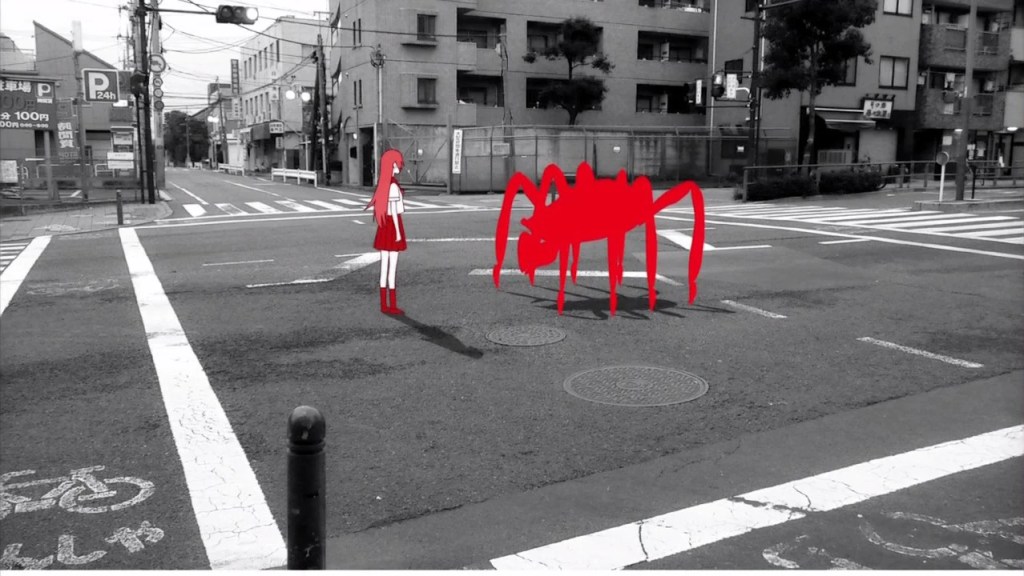
With a heart fractured and hurt, Hitagi slipped away from her life as an outgoing high school student, shedding her connections to friends like Suruga Kanbaru, an underclassman who worshiped her. Hitagi’s turmoil culminated in an encounter with a minor god, the Heavy Stone Crab. This crustaceous apparition made her a tantalizing offer: it would free her of her emotional burden, the devastating weight of her assault and her mother’s subsequent betrayal. Hitagi readily agreed, though the deal had its own cost. The “weight” the crab took from her is represented by a toll it takes on her physical body; after the exchange, she weighed little more than the air itself. And it isn’t only her negative emotions she is rid of by the time she meets Araragi. Hitagi Senjougahara feels nothing at all.
When Araragi learns of the horrific circumstances that led to Senjougahara’s weightlessness, he strives to help her however he can. Due to his own lack of self-esteem and experience, he instead suggests that she accompany him to consult with Meme Oshino, an expert in handling the supernatural. Throughout Bakemonogatari‘s five arcs, Araragi gradually handles more of each apparition case on his own, slowly shedding his reliance on Oshino’s guidance. However, by the time “Hitagi Crab” starts, Oshino has proven vital to Araragi’s two previous brushes with the otherworldly. Senjougahara is initially reluctant to accompany him, uncomfortable with anyone knowing her secret curse; in the past, she has also fallen prey to numerous scam artists who promised to resolve her curse and restore her missing weight, inadvertently losing more of her father’s now-disparate funds in the process. Araragi sways her by sacrificing his own comfort: he shares a secret of his own, exposing his vampirism and, in the process, willingly opening himself up to another. This act earns a sliver of Senjougahara’s trust, and for the first time in years she finds herself clinging to the hope that this time she may finally return to normal. For the remainder of “Hitagi Crab” and the duration of each of Bakemonogatari‘s subsequent arcs, Araragi and Senjougahara cultivate a relationship that forces them to individually mature in order to do right by both themselves and each other. Their evolving connection is the beating heart of the series, showcasing the beauty and complexity of human links, the experiences and education only made possible by being open to others.
Oshino immediately identifies Senjougahara’s affliction, and he instructs her on how to prepare for a ceremony where they will potentially rid her of it for good. One of these steps is to dress in a ceremonial white, something she must return home to do. Araragi accompanies her, and it is there the two truly begin to connect. She seemingly lives alone, in a relatively small home that is a far cry from the mansion she grew up in. Her father is nowhere to be found, working long hours to recover from the family’s financial devastation and provide for Hitagi’s future. When they are alone together, the lingering effects of Senjougahara’s tragic past are on full display in her behavior toward her new friend. She is verbally aggressive, berating Araragi at every opportunity. He frequently refers to her as a “tsundere” in both this and later arcs, though the validity of that term is questionable. The tsundere archetype in anime is represented by a character, usually female, behaving coldly toward others outwardly while secretly harboring more compassionate feelings toward the subject of their apparent disdain. Senjougahara clearly already has some attachment toward Araragi, but her lack of feeling is as real as it gets; after all, she sacrificed her emotions to be rid of the pain caused by both her mother and attacker. Both Senjougahara’s assault and the crab’s curse have left her with a detachment from her own body, one she displays when she prepares for a shower in front of Araragi, apathetic toward any potential reaction he may have when exposed to her nude form. With his classmate showering in the bathroom whose door is left open, Araragi sits alone in her apartment, clearly uncomfortable, trying to solve the puzzle of Hitagi Senjougahara.

After her shower, Senjougahara continues to display indifference toward being nude in front of her male classmate, a behavior she contemplates in a later arc in the series. This unconcern is representative of her general disconnect from her life, from how others see her. While dressing for the upcoming ritual, she and Araragi verbally spar, teasing and digging at each other in a way that betrays a burgeoning intimacy. Though her constant barrage leaves him flustered, Araragi clearly enjoys the rapport he has with Senjougahara. Together, they slowly build a relationship based on conversation, on the simple joy one can feel just existing in the presence of someone they are fond of. Araragi develops unique bonds with most of the series’s major characters, but there is no connection like that he has with Senjougahara. Once she is prepared for the upcoming confrontation with the Heavy Stone Crab, the duo sets off to meet Oshino.
In the meantime, Oshino has prepared an altar for their midnight ceremony. As the ritual begins, he grills Senjougahara on her meeting with the crab, asking questions to spur the minor god into appearing before them. When he asks Senjougahara about her most painful memory, the crab does finally appear. As she fails to answer and truly grapple with the pain she buried so long ago, the crab—visible only to her—attacks her. Oshino steps in to help, but Senjougahara realizes the only way to truly conquer her problem is to face her own trauma, to accept the hard emotions with the good, to begin to heal. Senjougahara apologizes to the god for her initial selfish wish, asking its forgiveness for having it bear her emotional burden on her behalf. She asks for her feelings back, even with the understanding that to do so will irrevocably sever her relationship with her mother. In other words, she knows that allowing herself to feel again will make forgiving her mother’s betrayal impossible. Still, tired from the years of emptiness, inspired by the kindness of two strangers, she chooses to open her heart again. After all, throwing away her feelings was never a real solution to her problems. To begin to heal, she has to accept the wrong done to her. She has to allow herself to process the complex and troubling emotions that come with being truly wounded, even if that process is difficult and uncomfortable. The crab accepts her resolve and returns her emotions, a metaphysical exchange expressed by a sudden burst of sadness in Hitagi, a river of tears flooding down her face. Araragi and Oshino watch on.
By the final moments of “Hitagi Crab,” Araragi and Senjougahara have formed a profound connection, something that neither have experienced before. In Hitagi, Araragi sees someone who is much like him: wounded by the world, she sunk into herself and closed herself off to feeling. However, by the end of the arc, Araragi has seen her laid bare. In going out of his way to reach out and help her, he has truly opened himself up to another for the first time. Throughout Bakemonogatari‘s following arcs, the duo builds on this newly kindled connection, slowly establishing a relationship that can stand the hardships of conflict and time.
Mayoi Snail

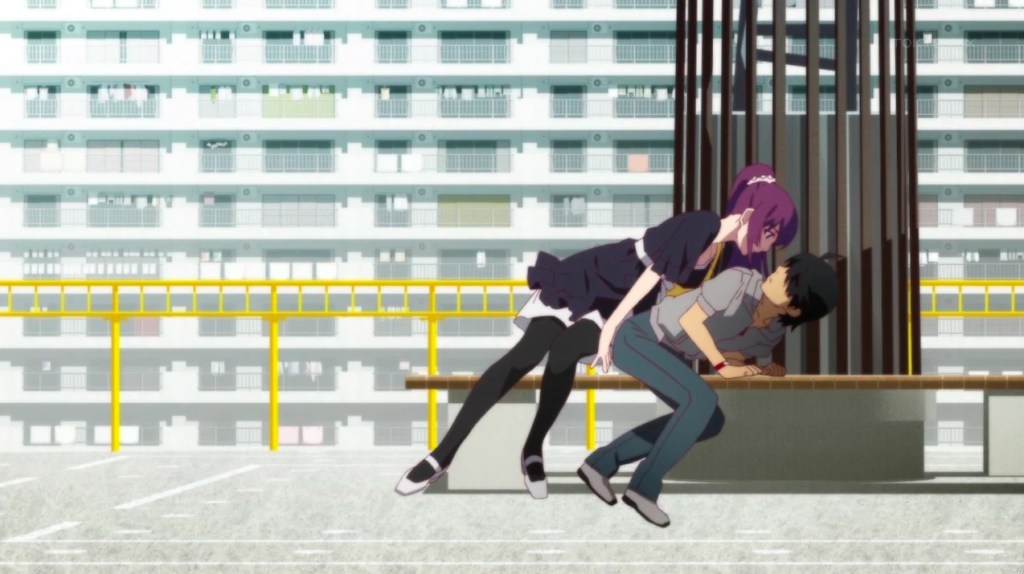
Though Senjougahara is not the named protagonist of the second arc, “Mayoi Snail,” the story still showcases the duo’s newfound friendship blooming into a budding romance. The arc takes place in a city park over the course of Mother’s Day, and each of the four characters who appear throughout its three episodes grapple with their own maternal issues. As the story begins, Araragi has fled to the park to escape his own family. He believes his mother favors his two younger sisters, and he can’t stand to be around them all doting on one another. While sitting alone, the first person he encounters in the park is none other than Senjougahara; with her own strained relationship with her mother, she has reasonably chosen to spend the day outdoors, keeping her mind off of it. During this meeting, Senjougahara begins to show signs of opening up, demonstrating her slow healing. She shows off an outfit she has only just bought. This flusters Araragi, who is clearly attracted to her—though this goes far beyond her physical beauty. Their true chemistry is only on full display when they banter back and forth, playing word games and trying to catch each other off-guard. There is a loveliness in relationships built on conversation, on a true emotional connection between minds. Looks aside, it is the way the two can spend an afternoon talking that really draws them together. But healing is not a quick process; Senjougahara still falls back on a defensive caginess, baffling Araragi with sudden barbs. She insists on paying him back for his assistance, offering to grant him anything he could desire. Though this is clearly innuendo, Araragi sees through it, understanding that her frank sexuality is merely an act, part of the shell of survivability she created to cope with the last few years. However, though she beats around the bush, her romantic feelings for Araragi are apparent for anyone with a shred of emotional intelligence. Unfortunately, Araragi is too dense, too unaware of his own value, to pick up on Senjougahara’s desire. This conversation is depicted entirely through Araragi’s subjective perspective, making it unclear exactly how much of Senjougahara flirtatious behavior is reality and how much is only his own wishful thinking. One moment Hitagi will be leaning over him, threatening to outright press her body against his own. Then Araragi will blink, and the girl will be standing a respectful distance away, nothing but a kind smile on her face. While Senjougahara is now much more upfront with her attraction toward Araragi, his feelings are depicted more subtly through means of the production. Careful attention to camera placement and editing reveal that the creative direction is conveying Araragi’s inner desires to the viewer. After all, he is Bakemonogatari‘s narrator, and due to his reserved character, it would be unlike him to spell out his wants to the audience.
The central plot of the arc centers around Mayoi Hachikuji, an elementary school student who can’t find her way home. Though she is initially aggressive toward Araragi’s offer of help, she eventually relents and allows the pair of high school students to guide her home. Through all of this, Senjougahara observes quietly, her thoughts hidden behind a neutral expression. As they traverse through the city, Senjougahara leads the way and Hachikuji hides behind Araragi, unwilling to get close to the other girl. Though Hachikuji claims it is only because Senjougahara’s prickly personality terrifies her, there seems to be more going on than meets the eye; this is hinted at by the concerned looks Hitagi shoots Araragi each time he speaks with the elementary school student. Unable to find their way to Hachikuji’s home, the trio returns to the park. Though his first attempt to help the girl failed, Araragi always has a fallback plan: Meme Oshino, the man who has, until this point, always ultimately solved his problems. However, in the past Araragi has always had to approach Oshino himself, grappling with apparitions alone until desperation forced him to reach out to his mentor. Now he has a fledgling partner in Senjougahara, who offers to seek out Oshino herself so that Araragi can wait with Hachikuji in the park. When she returns, however, she reveals that she had a hidden motive for offering to make the trip herself: despite Araragi’s contentious dialogue with Hachikuji and his persistent desire to see her safely home, the girl is invisible to Senjougahara. In her view, Araragi has been speaking only to himself, insisting they escort home a girl who may or may not even exist. Hitagi has held her tongue until this point, afraid both of how Araragi would react to the revelation and the possibility that being unable to see Hachikuji was a sign of her being affected by some other curse.
Hachikuji herself is the apparition, and Araragi is actually the afflicted one in this case. Through a defeated monologue, Hachikuji details her death in a traffic accident. She is another victim of a broken home; her parents’ separation left her mostly alone in her father’s custody. Missing her mother, she set off on her own into the city and was killed when run over at a crosswalk. Now she is essentially a ghost, haunting those who, in their own way, wish to be lost and unable to return home. Due to his familial unrest, Araragi is an easy target. Tsubasa Hanekawa—who briefly stopped by and conversed with Araragi and Hachikuji while Senjougahara was away—is also able to see Hachikuji, due to her own domestic struggle. Without the catharsis she experienced during the climax of “Hitagi Crab,” it is possible that Senjougahara would have also fallen victim to the apparition. However, due to her personal growth, she resists the curse and is able to help Araragi solve this new oddity-related issue and provide Hachikuji some personal resolution.
The high school seniors agree to escort Hachikuji home, something they should now be able to do now that they are both aware of the true circumstances surrounding the apparition. However, Araragi first suffers an emotional outburst at the unfair reality of it all, that the girl who seems so real to him is only the ghost of a child whose life was taken far too soon. In a way, this breakdown mirrors the very one Senjougahara experienced at the end of the previous arc—but now the roles are reversed, with Hitagi standing steadfast at his side, providing quiet support as he processes difficult feelings. This shared emotional support coupled with the partnership with which they tackle the Hachikuji issue demonstrates an equitable bond between them, a strong foundation from which a healthy relationship can bloom. The trio arrives at Hachikuji’s former home, now an empty lot. The elementary schooler experiences a catharsis much like Senjougahara’s in the first arc, the honest tears brought forth by a long journey’s ending. She fades away, freeing Araragi from her curse.
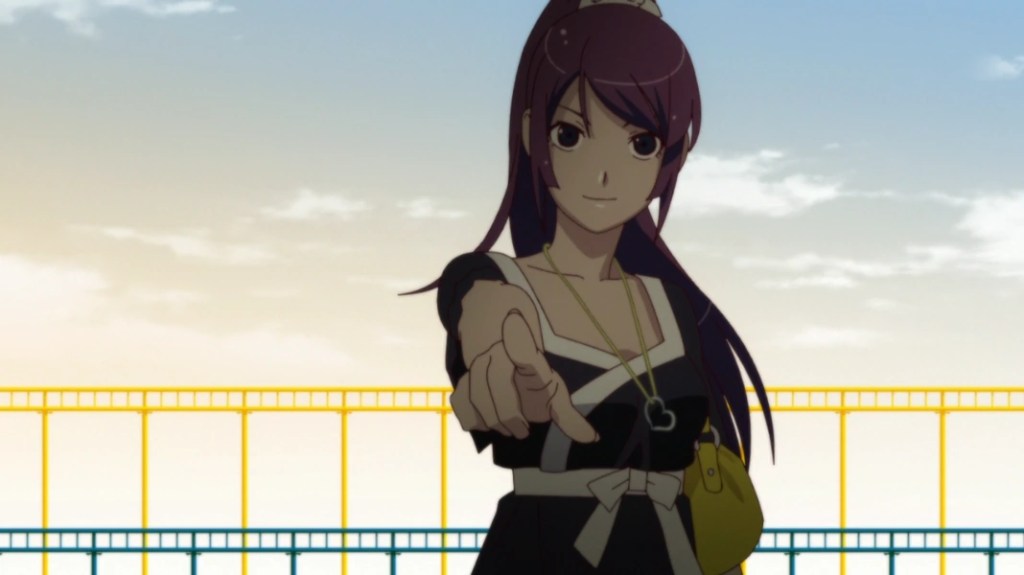
As he stands bewildered by the afternoon’s events, Senjougahara startles him further with an uncharacteristic confession: she tells Araragi that she has fallen in love with him. While she admits to a physical attraction and enjoying their unique rapport, the root of her love lies in who Araragi inherently is. He is someone who would drop everything to help anyone, no matter their identity or circumstances. This is who he is boiled down most simply, and it goes beyond the gratitude she feels toward him helping her with her own affliction. Her feelings solidified when watching him commit body and soul to aiding Hachikuji, a girl he had only met hours before. In working with him to solve the day’s curse, Senjougahara believes she has learned who he really is, and what she sees she loves. Though her confession is sudden, she pleads that Araragi does not dawdle in his response, that he answers her feelings as bluntly as she expressed them. While he is much more taciturn than the improved Hitagi in terms of verbalizing his feelings, it is no surprise when Araragi agrees to date her. All along, the series’s direction has demonstrated his growing fondness for her, the camera placement often emulating the way he looks at her. However, Araragi rightfully calls out Senjougahara’s decision to keep secret her inability to see Hachikuji, no matter how noble her intention in doing so. Relationships should be built on honesty and shared trust; Araragi asks Senjougahara to always be open with him, to be a true partner in all respects. With all laid bare and agreed upon between them, they begin dating.
Suruga Monkey
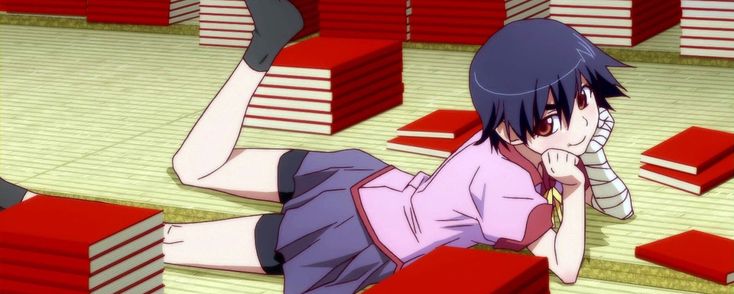
Now one half of a committed couple, Araragi has new emotional issues to work through in order to be a better person and partner. Just like all real romantic relationships, both Araragi and Senjougahara are imperfect people, somewhere on their own individual roads to an unreachable personal perfection. However, making a relationship work requires constant work, both on the central bond and the improvement of the individual. Araragi is still saddled with self-doubt and detachment, flaws that run the risk of damaging any relationship. And Senjougahara is his first girlfriend, which means that he needs to learn how to even be part of a couple in the first place. One of the first elements he must grapple with is a universal struggle for most people in relationships, especially within the early stages: the tendency to wonder about a partner’s past, the resulting jealousy over their previous experiences with others. This internal turmoil is the thematic core of “Suruga Monkey,” Bakemonogatari‘s third arc.
While walking to school, Araragi encounters Hachikuji, the ghost girl he only recently believed had passed on forever. She is now a wandering spirit, relegated to traverse the earth as she wills. Their conversation is interrupted by Suruga Kanbaru, Araragi’s athletic underclassman. Kanbaru has been tailing Araragi lately, seemingly interested in him due to his new relationship with Senjougahara—her friend from their time as middle school sports superstars. Kanbaru’s most notable feature is her left arm, mysteriously wrapped in bandages.
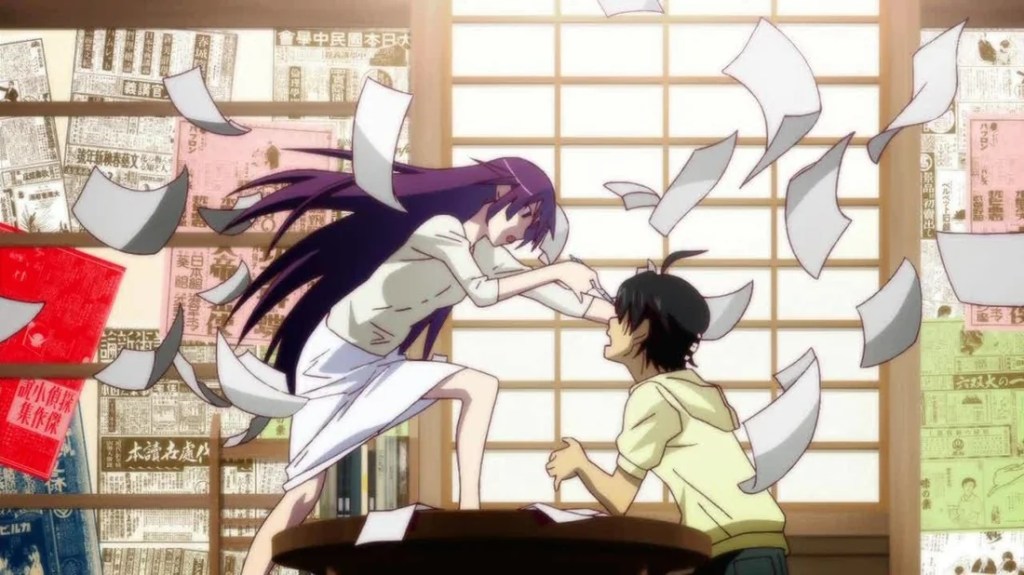
The bulk of Monogatari takes place during Araragi’s senior year of high school, a year that for most people serves a sort of a nexus between a relatively predictable life where choices are mostly made for you and then the rest of it, the ever-expanding unknown where most adults struggle to find purpose, financial success, family. The setting is key. Araragi stands at a crossroads. Initially, as Bakemonogatari begins, he is aloof and riddled with apathy as far as his future is concerned. However, his work solving the various apparition cases involving the likes of Hanekawa, Senjougahara, and Hachikuji has slowly helped him form some semblance of an identity. As mentioned by Senjougahara in the last arc, Araragi is in simplest terms someone who aids others in times of need. And his relationship with Senjougahara also becomes a crucial force in his drive to prepare for a better future. She is a star student, one with strong prospects to be accepted into distinguished universities. Araragi now attends regular study dates at her home, where Senjougahara does her best to prepare him for college entrance exams. This is all despite Araragi rebuffing a similar offer from Hanekawa in Kizumonogatari; in the novel, he refers to himself as “a lost cause” as far as the future is concerned. When alone with Araragi, Senjougahara gradually opens up little by little, demonstrating snippets of emotional vulnerability that would have been impossible without resolving her past affliction with Araragi’s help. No longer does she wield stationary as weapons, brandishing pencils or staplers at anyone who tries to make more than small talk with her. Still, there are flashes of the defensive Senjougahara who Araragi initially met, moments where her cagy combativeness flares at him. At one particular study session, Araragi asks her if she knows Kanbaru, and Senjougahara’s vague description of their former relationship leads him to fall into the same trap as many others who enter relationships in the real world. He wonders about her past, if the relationship between the girls was something more akin to what he now shares with Hitagi. After all, she has only stated that she has never been with a man before, making no claim either way about being with another woman. As Araragi ponders this, Senjougahara presents him with the cash payment she owes Oshino for his assistance in ridding her of the Heavy Stone Crab. However, Araragi forgets it when he leaves for the evening, prompting her to follow him.
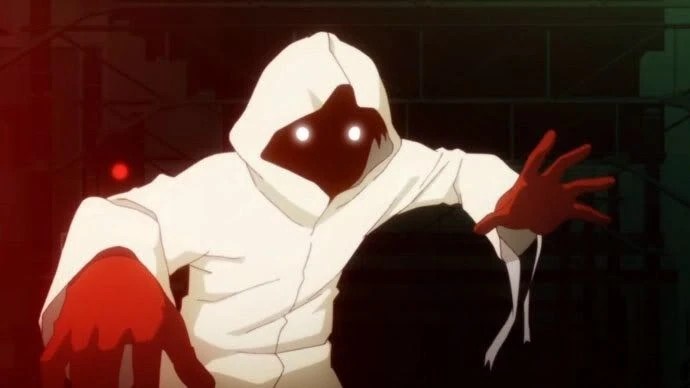
As Araragi makes his way home, he is ambushed by a strange figure, one shrouded in a brash, yellow raincoat. It pummels him with superhuman strength, severely wounding even his vampirically-enhanced body. The assault only ends when the attacker flees at the arrival of Senjougahara, who has managed to catch up with Araragi in order to deliver Oshino’s payment. She waits with him while his body slowly heals, wary of his excuse that his grisly wounds are merely the result of falling off of his bike. In lying about the violent encounter, Araragi is already breaking the promise he asked Senjougahara to make. While his motive is not explicitly stated, it is likely to keep her outside of his world of curses, an honestly foolish notion due to the very circumstances that led them to meet. Still, he is lying to protect her, to keep her at arm’s length from the trail of horrors that seems to follow him. However, this lie is made even worse when considering that the promise they made at the beginning of their relationship was mostly about not lying to each other regarding apparitions. Araragi’s choice is a clear sign of naivete, a belief he can shield the girl he cares most for from the evils he encounters on a regular basis, that keeping her safe is more important than building a relationship rooted in total honesty.
Spurred by his girlfriend’s mysterious past with Kanbaru, Araragi seeks out information about his underclassman. He questions Hanekawa, who remembers the other girls from middle school. Hanekawa warns Araragi about the dangers of investigating the past of one’s partner, the lack of trust that such a hunt belies. Still, she tells him what she knows: Senjougahara and Kanbaru were an inseparable duo, known for being the star athletes in track and basketball, respectively. Araragi receives the rest of the story from Kanbaru herself, and his worst fears are in a way realized. When he visits her at her home, Kanbaru details the bond she shared with Senjougahara only a few years before. While it wasn’t reciprocated, Kanbaru harbored romantic feelings for Senjougahara, and she shows no sign of that desire being dead. Araragi can easily conclude that the girl has been following him on an investigation of her own, seeking out what Senjougahara could possibly find appealing about him. The girls’ relationship ended when Kanbaru stumbled upon Senjougahara’s secret affliction. When Kanbaru confronted her with a desire to help, Senjougahara, wounded by so many with false intent before, lashed out at Kanbaru, attacking her with her stationary armory. In a seemingly unrelated gesture, she reveals the bandages on her left arm conceal an ape-like appendage, the normal limb replaced by dark fur and a monkey’s powerful paw. She shows Araragi the gnarled hand of what she and her grandmother discovered years before, something they believed belonged to a monkey.
In both this initial conversation and a later one with Meme Oshino, Kanbaru’s shadow-clad backstory is made clear. As a child with knowledge of W.W. Jacobs’s short story “The Monkey’s Paw,” Kanbaru believed the disembodied hand she discovered was similar to the story’s namesake artifact. In the original tale, the monkey’s paw could grant three wishes made on it, but each wish would be granted in the least desirable way possible. For example, the elderly couple that the story revolves around wish for a sum of money. Their monetary desire arrives with the news of their son’s death at his factory job, his workplace sending over the cash payment as a gesture of good will. Believing the object she found would similarly grant wishes, Kanbaru first wished to be the fastest runner in her class, a wish that manifested in her rivals being conspicuously absent on the day of a race. She later discovered that they had all been violently attacked the night before. Horrified by the power of the monkey’s paw and the resulting transformation of her left arm, Kanbaru hid the strange object and refused to use it again. That changed when she heard that Senjougahara, the girl she loved but who shoved her away, had entered a relationship with someone else. Upon discovering Araragi’s identity, Kanbaru returned to the monkey’s paw with a desperate plea: she wished for Araragi to die by whatever means necessary. Oshino pieces together the truth from Kanbaru’s story. The hand doesn’t belong to a monkey at all; it is instead an artifact of another oddity, the Rainy Devil. The apparition achieves Kanbaru’s wishes by possessing her body and using it to violently assault those who stand in the way of what she desires. Kanbaru herself is the raincoat-clad assailant who nearly beat Araragi to death on his ride home.
Kanbaru’s plight is compelling because it reflects one of the recurring themes of the series, the cycle of hurt people developing defensive coping mechanisms that inadvertently bring harm to others. Her attempt to help Senjougahara, whom she loved and idolized, was met with violence and distrust, wounding Kanbaru as a result and suffusing her heart with the darkness that later drove her to wish death on Araragi, someone she should otherwise have no ill will toward. Her envy of Araragi’s relationship with Senjougahara leads her to these drastic measures, tapping into her most evil secret desires. Oshino correctly assesses Kanbaru as someone whose outward kindness masks a deep-seated venom. In taking possession of Kanbaru’s body, the Rainy Devil is only acting on her most vile base impulses, such as when it assaulted her athletic rivals several years before. In many ways, Kanbaru parallels Araragi; most of his early actions in “Suruga Monkey” involve researching Senjougahara’s past, driven by morbid curiosity to know everything about his new partner. While Kanbaru is jealous of him, Araragi is also jealous of her and the mysterious role she once played in his girlfriend’s life. Her oddity-afflicted body is an extreme, twisted version of what Araragi could be if he allows the negative feelings inherent in new relationships to possess him. In her introductory arc, Kanbaru serves as a cautionary tale for the emotional conflict brewing within Araragi.
Oshino estimates that there are only two ways to stop the Rainy Devil now that a wish remains unfulfilled: they could sever Kanbaru’s transformed left arm, cutting the connection between her and the demon, or they could allow the monster to kill Araragi, fulfilling Kanbaru’s wish. Oshino theorizes, however, that if the demon tries and finds itself unable to kill Araragi, the contract between Kanbaru and the Rainy Devil will be rendered void, forcing the apparition to leave her be. Though the chance of this happening is very slim and Kanbaru willingly offers to have her arm removed, Araragi opts for the more reckless option. Thanks to his vampiric body, he does stand a chance to survive a one-on-one battle with the Rainy Devil, even if the odds are not in his favor. This decision reflects a few key psychological factors plaguing Araragi, but most notably his internal self-loathing, the unshakable guilt he feels over Kanbaru’s condition. In his mind, Kanbaru would not be beholden to the Rainy Devil if Araragi hadn’t entered a relationship with Senjougahara, if he didn’t exist at all. If he loses his life in a battle with the monster, he feels like it is justified since he indirectly brought about Kanbaru’s desperate wish in the first place. This act is a perfect example of Araragi’s complex motivation behind the self-sacrificial way he tackles the problems of others; his sense of justice always wins out over every inhibition, and his inherent apathy toward himself prevents him from caring about the danger to his own well-being.
As a possessed Kanbaru waits for him in one of the cram school’s spare rooms, Araragi borrows power from Shinobu by allowing her to feed on more of his blood than usual. He doesn’t need to overpower the Rainy Devil to defeat the apparition; he simply needs to survive for long enough that it gives up on fulfilling the wish and severs its contract with Kanbaru. While Oshino is generally amused in even the grimmest of circumstances, he seems especially aloof when allowing Araragi into the arena with Kanbaru. It is as if he somehow already knows the outcome, or has information that Araragi does not regarding the upcoming bout. When the battle finally begins, Araragi is easily outmatched. Despite his best efforts, the Rainy Devil rips him apart, breaking his bones and ripping his intestines from his body. However, before the apparition can deliver the final blow, Senjougahara arrives—contacted in advance by Oshino, who knew all along that the only way to save both Kanbaru and Araragi was to have Hitagi intervene. She chastises Araragi for lying to her, doing the very thing he made her promise not to do in the conclusion of “Mayoi Snail.” They are supposed to be partners in all things, especially apparitions, and they agreed to be honest even when it was difficult. Araragi, spurred on by negative feelings toward himself, fell into a spiral of lies when trying to handle Kanbaru’s affliction on his own. Senjougahara stepping in is the first time he is truly saved by another, making them emotionally equal after his attempt to rescue her in “Hitagi Crab.” Senjougahara threatens the Rainy Devil, who is unable to harm her due to Kanbaru’s unrequited love. Hitagi warns it that if harm comes to Araragi, she will stop at nothing to enact vengeance on Kanbaru. With this interruption, the apparition is no longer able to complete its contract; as a result, it finally leaves the girl alone.
The final battle in “Suruga Monkey” is in many ways only a physicalization of the emotional conflict between the three characters at its center. On the surface, both Kanbaru and Araragi feel as if Araragi is the better candidate for Senjougahara’s love: she is athletic, confident, seemingly happy, and dotes on Senjougahara in an obsessive way that Araragi likely never will. Araragi drifts through his life, taking each day as it comes. He is not outwardly bright, typically appearing aloof and sullen to others. His jealousy and subsequent investigation of Kanbaru earlier in the arc stemmed from his jealous belief that she was the more sensible choice for Senjougahara, his inability to see why a girl like Hitagi would pick him over anyone else. So of course the Rainy Devil decimates Araragi in their physical conflict, one that is only representative of the thematic clash underneath its surface. And of course the battle only ends when Senjougahara arrives and definitively chooses Araragi, making clear her love for him and that she holds him above all others. Still, as she crouches over Kanbaru, Senjougahara admits her wrongdoing in shoving the other girl away. While she can’t be her romantic partner, she still offers to repair their friendship, a gesture that Kanbaru tearfully accepts. As Araragi’s ruptured body begins to stitch itself back together, he ruminates on the arc’s events, now forced to accept that the love Senjougahara has for him is something true.
Nadeko Snake
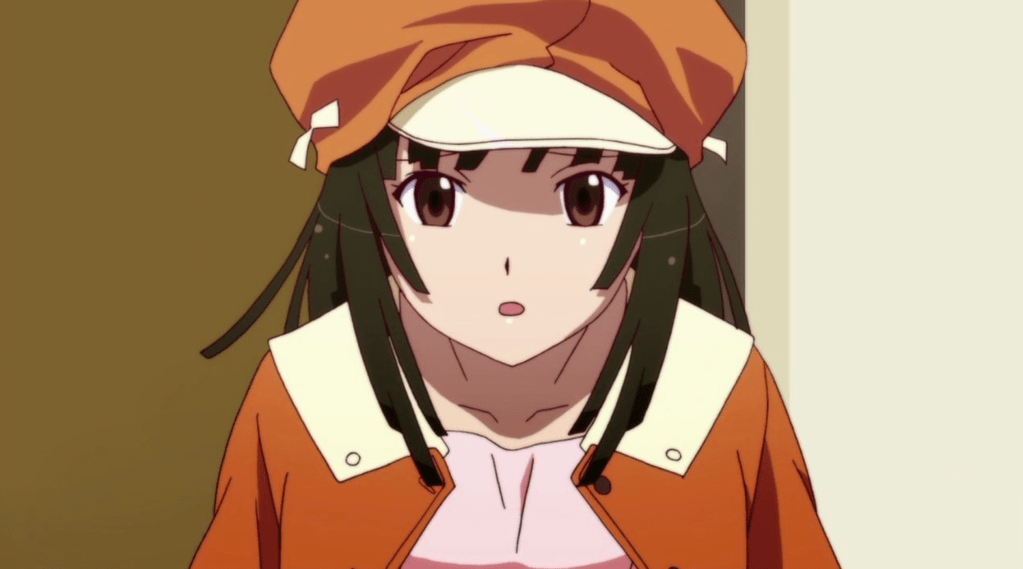
While Senjougahara is arguably the central heroine in Bakemonogatari, she hardly appears in the fourth arc, “Nadeko Snake.” The arc instead primarily explores Araragi and his drive to save others, forcing him to grapple with the moral quandaries associated with following a path of justice. As the story begins, Araragi travels to a mountain shrine alongside Suruga Kanbaru. Their trip together was orchestrated by Senjougahara, reflecting her desire to patch up the fledgling bond between her boyfriend and underclassman. With Araragi the definitive victor in their romantic rivalry, Kanbaru’s animosity has faded. Now they are fast friends, and Kanbaru easily establishes her own pattern of prodding and teasing Araragi. They soon cross paths with Nadeko Sengoku, a girl from Araragi’s past who is seemingly fleeing the shrine. Though Araragi hardly recognizes her due to the time that has passed since he last saw her, Nadeko is actually longtime friends with his younger sister Tsukihi. At the shrine, he and Kanbaru discover a massacre of white snakes. Later, Araragi spots Nadeko at a bookstore, researching curses. This pattern of odd behavior prompts Araragi to investigate Nadeko and her mysterious situation.
While at the bookstore, Araragi has a key conversation with Tsubasa Hanekawa about his relationship with Senjougahara. Hanekawa notes the similarities between the two, arguing that their relationship makes sense to her even if it does not to others. She correctly describes both Araragi and Senjougahara as being closed off to others, both having the conflicting feeling of love for people but hatred for actually having to deal with them. Hanekawa thinks that this is exactly what draws them to each other, and she points out that both Senjougahara and Araragi are slowly becoming more involved in the lives of others as a direct result of their intimate connection. Though Araragi is often unsure of what Senjougahara sees in him, Hanekawa frequently serves as a pillar of support, offering rational observations about what makes their relationship work.
What he discovers about Nadeko’s ailment reflects one of Bakemonogatari‘s recurring ideas. Nadeko is yet another victim of human cruelty, bullied by middle school classmates out of envy and spite. Due to her cute physical appearance, Nadeko easily catches the attention of the boys in her class, often becoming the object of their affection. However, Nadeko has only ever had eyes for one person: Araragi, the kind and quiet brother of her childhood friend. She ignores the advances of others, though one such rejection resulted in her current predicament. When Nadeko denied one particular boy, she was cursed by a jealous female classmate who had feelings for the boy and felt jilted by his preference for Nadeko. The curse takes the form of an invisible serpent that coils around Nadeko’s body, leaving rashes with scale-like imprints wrapped around her. Upon consulting with Oshino, Araragi discovers that the curse will eventually kill Nadeko; her own efforts to expel the curse, such as slaughtering snakes at the shrine, only exacerbated the issue, angering the snake and accelerating her upcoming demise. Nadeko’s issue highlights the importance of people like Oshino in the world of Monogatari. With only books and anecdotal advice to guide her, Nadeko’s meddling only worsened her situation. But apparition experts like Oshino can be hard to come by, and they come equipped with hefty prices. Someone like Araragi, a journeyman in all things occult who acts out of a sense of justice, is vital in order to protect hapless victims of curses from certain doom.
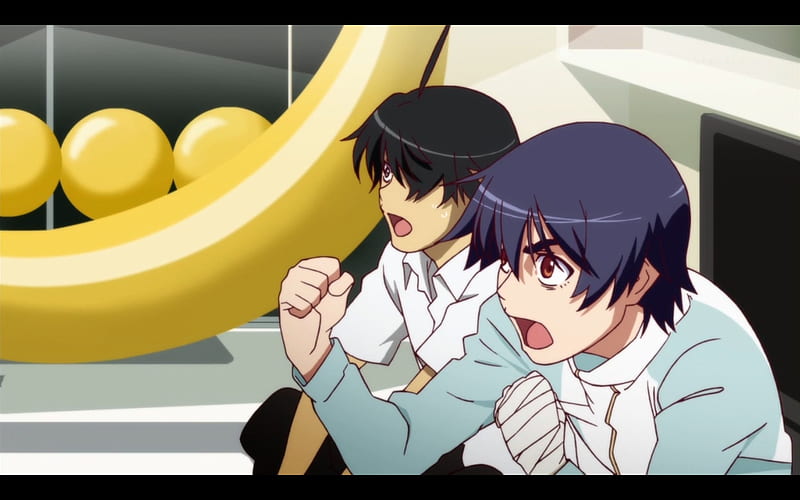
With Oshino’s guidance, Araragi and Kanbaru travel to the shrine from the arc’s opening moments, preparing a ritual to absolve Nadeko of her curse. Their attempt to help her initially seems successful; however, after supposedly eliminating the apparition, Nadeko begins to writhe in a newfound anguish. Araragi and Kanbaru deduce that Nadeko is not the victim of one curse, but two: the boy she rejected must have placed his own curse on her. Now, the second snake—enraged by the ritual resolution of the first—strangles Nadeko, intent on finally killing her. This desperate situation showcases Araragi’s resolve, again demonstrating his quintessential tendency to throw himself into danger for anyone else’s sake. There is no time to prepare a second ritual, so the only way to save Nadeko is to remove the invisible serpent by force. Engaging his vampiric strength, Araragi rips the snake free—though that only causes it to attack him. With the information that letting the snake go will only cause it to seek out and afflict the person who summoned it, Araragi puts his life on the line for the very stranger who caused the conflict in the first place. He restrains the snake, unable to bring himself to let it go and harm someone else, even as it tears into his flesh and drags him toward a tragic death. But, as mentioned toward the beginning of the essay, Kanbaru rescues him from his own self-sacrificial nature. She tackles Araragi and forces him to release the snake. As it slithers back home toward the person who summoned it, Araragi is forced to confront his own naivete: saving everyone with no casualties is a foolish dream, and, as Kanbaru pleads for him to do, Araragi must learn to be more selective in who he saves. There will be encounters with curses where he must choose to protect those he loves rather than strangers who selfishly brought about the issue in the first place. This idea is arguably a selfish one, and it conflicts with Araragi’s sense of justice, his childish desire to prevent harm from befalling anyone. In the business of helping others, tough choices need to be made. The struggle at the shrine is a wake-up call for Araragi, one of the first moments where his core values are challenged in a compelling way. For the first time, he must seriously consider that, in the grand scheme of things, not everyone may be worth saving, that he should perhaps not throw his life away and sacrifice his own happiness to prevent harm from coming to someone who really brought it upon themself. Throughout the series, Araragi shows a clear pattern of blaming himself for other people’s problems, making it easy for him to throw his own life away if it means benefiting another. In Kizumonogatari, Araragi denounces his own existence when offering his life to save the wounded Shinobu: “There isn’t a single reason for me to bother staying alive, not a single reason for me to value my own life over someone else’s, the world wouldn’t care one bit if I died!” This idea, alongside others presented in the conclusion of “Nadeko Snake,” are delved into much further in Bakemonogatari‘s final arc, “Tsubasa Cat.”
First Date
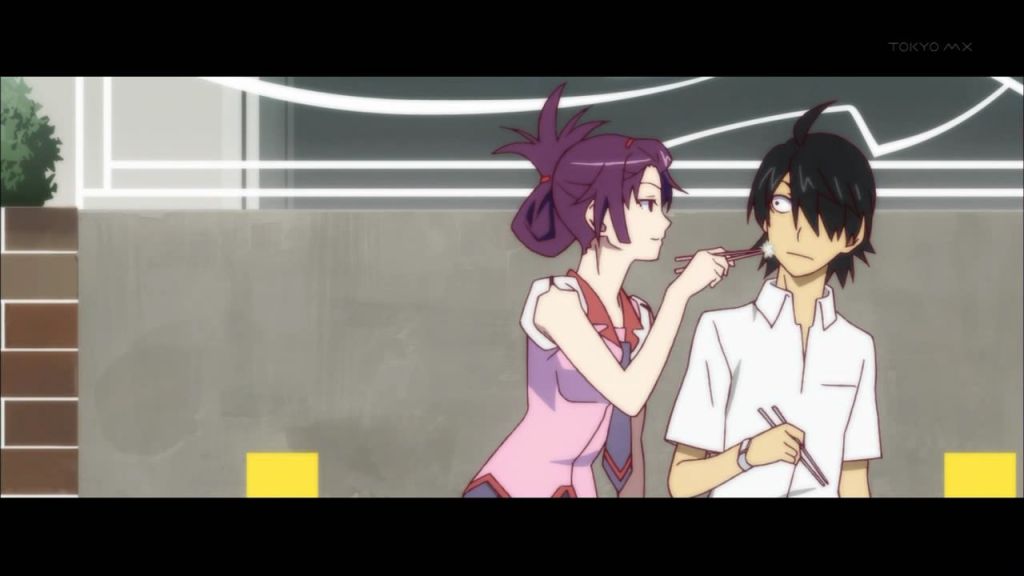
While Bakemonogatari‘s final five episodes are technically all considered part of the same “Tsubasa Cat” arc, the structure of this section of the anime is odd when compared to the rest of the series. There are multiple reasons for this, but the most notable one is that Bakemonogatari had only 12 weekly broadcasting blocks, meaning that only 12 of its 15 episodes actually aired on television. Due to “Nadeko Snake” ending on episode 10, the creative team only had two broadcast episodes left to reach a satisfying conclusion by the end of episode 12, even though the next arc they had to adapt, “Tsubasa Cat,” would take more than two episodes to play out. As a result, episodes 11 and 12 almost serve as standalone tales, with each directly foreshadowing and setting up the events that would play out over episodes 13 through 15. These final three episodes eventually aired online, and they depicted the bulk of the “Tsubasa Cat” arc’s events.
Episode 11 is technically the first in the “Tsubasa Cat” arc, though it mostly serves as a recap of events in Tsubasa Hanekawa’s past that at this point had not been revealed in detail, only alluded to by Meme Oshino. As explained in greater detail earlier in the essay, Araragi spent his recently passed Golden Week investigating the feline apparition plaguing Hanekawa. He ultimately enlisted Oshino in resolving the monster, one that changed Hanekawa’s appearance and acted on her hidden impulses. The oddity came about in a response to repressed stress, mostly stemming from Hanekawa’s horrible domestic life. Raised by a widowed stepfather and his second wife, Hanekawa is often subjected to their physical abuse. Upon awakening, the cat apparition sapped the energy from Hanekawa’s adoptive parents, leaving them close to death. It then went on a similar spree throughout the city, only stopping when Araragi and Oshino intervened. Shinobu Oshino, the blonde vampiric child who initially afflicted Araragi with his own brand of vampirism, used her own abilities to seal away Hanekawa’s newfound powers. As a result, Hanekawa lost all memory of these events.
While this story is told in much greater detail in Nekomonogatari, a later season of the franchise, Bakemonogatari‘s 11th episode only recaps these events in brief. The rest of the episode follows Araragi conversing with Nadeko and then Hanekawa. His encounter with Nadeko is short, mostly consisting of her thanking him for his rescue efforts in the previous arc. However, his long conversation with Hanekawa is rife with analytical importance, introducing key themes and concepts that play out over the remainder of Bakemonogatari. Many of these pertain specifically to Araragi’s growing relationship with Senjougahara, highlighting more of his own insecurity and laying the foundation for the series’s emotional climax. However, they also flesh out Hanekawa’s important dynamic within said relationship, the different ways her presence affects Araragi’s love life.
Throughout the franchise, characters point out that Araragi’s relationship with Senjougahara makes little sense from an outsider perspective. As has been established throughout Bakemonogatari, both are reserved and socially aloof, seemingly allergic to forming connections with others. While Senjougahara was once a renowned star athlete, she has since withdrawn from extracurriculars. And while she is a great student and obviously intelligent, Hanekawa is the top of the class and student council president. She is also traditionally beautiful and easily broke through Araragi’s shell long before he had ever spoken to Senjougahara. Outside observers who know both girls, such as Hachikuji, comment that they would have expected Araragi to pursue Hanekawa, that a relationship between them theoretically makes much more sense than one with Senjougahara and her defensive edge. Araragi often struggles to quantify his feelings for Senjougahara himself, wondering what draws him to her or vice versa. However, this reflects a fact about relationships in the real world: they often do not make much sense to third parties, and even those involved may have a hard time describing what connects them to their partner. Whether it is random circumstance or raw chance, bonds form between people, often seemingly out of nowhere. But all that matters is that the bond exists. In a moment of vulnerability, two people connected, and the feelings that would eventually bloom into love took root. Araragi does not need to be able to explain his relationship, to defend why it works to outside commentators. What matters is that they fulfill something within the other, that they make up for each other’s shortcomings, that they meet each other’s flaws with love and support.
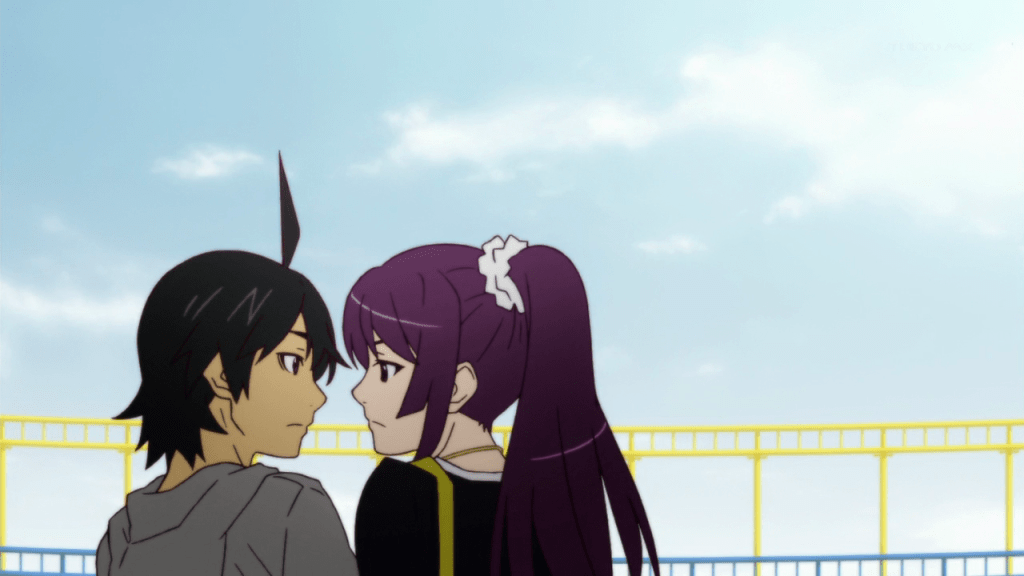
Still, it is hard to shut out the opinions of others, especially when grappling with your own perpetual insecurities. In his conversation with Hanekawa, Araragi learns that their teachers and classmates worry about his effect on Senjougahara. The general belief is that by dating Araragi, a long time loner and slacker, Senjougahara is slipping away from her education, that her blossoming personality as their relationship develops is actually a hindrance to her potential success. Araragi is already riddled with self-doubt and suffers from low self-esteem, so it is easy for him to believe that he is actually a problem, that he is holding Senjougahara back. He has shown time and again that he is not someone to choose himself or his own happiness, so hearing the gossip about his relationship hits him especially hard. He also struggles to see what Senjougahara even sees in him, why she would choose to date or put so much effort toward him in the first place. She credits him for rescuing her, but Araragi does not even believe he had much to do with that, instead thinking he just stood by as she saved herself. He feels the same way toward most of the apparition cases he has taken part in, diminishing his own role in their various resolutions.
Hanekawa then mentions his many new friendships with the girls he has helped, and she presents an interesting theory about their nature: she believes they may be the result of Araragi’s vampirism, that he is inadvertently exerting some supernatural charm over the girls. In other words, she believes that the relationships he has recently formed are actually artificial and would not exist without his affliction. The idea that Araragi’s vampirism is the only thing drawing these women to him serves as the perfect symbol for all of his insecurity and self-doubt, lending credence to his own inability to see why people seem to like him. This is obviously most important in the case of Senjougahara, whose love for him seems this brilliant, unknowable thing. Hanekawa’s theory confirms Araragi’s bias against himself, theoretically robbing his relationships of merit. Toward the end of their conversation, Hanekawa suffers a headache much like she once experienced when afflicted by the cat apparition, prompting the flashback that summarizes the events of the “Tsubasa Family” arc as explained earlier.
With a head full of doubt, Araragi agrees to accompany Senjougahara on their first real date together. While they have spent a lot of time together alone, it has mostly been studying or quick lunches at school. Senjougahara proposes a true romantic outing, a trip to a place of her choosing. Episode 12 is an isolated story, revolving entirely around this date. Monogatari frequently has episodes that basically only depict dialogue between characters, with little physical action other than characters walking from one place to another. One of the strengths of the series is that these episodes are never boring, that the conversations between the series’s strong cast of characters can be as gripping as one of the rare battle scenes. Episode 12 of Bakemonogatari is one of the best examples of this, and from the standpoint of dialogue and character development, it may be one of the single greatest anime episodes of all time.
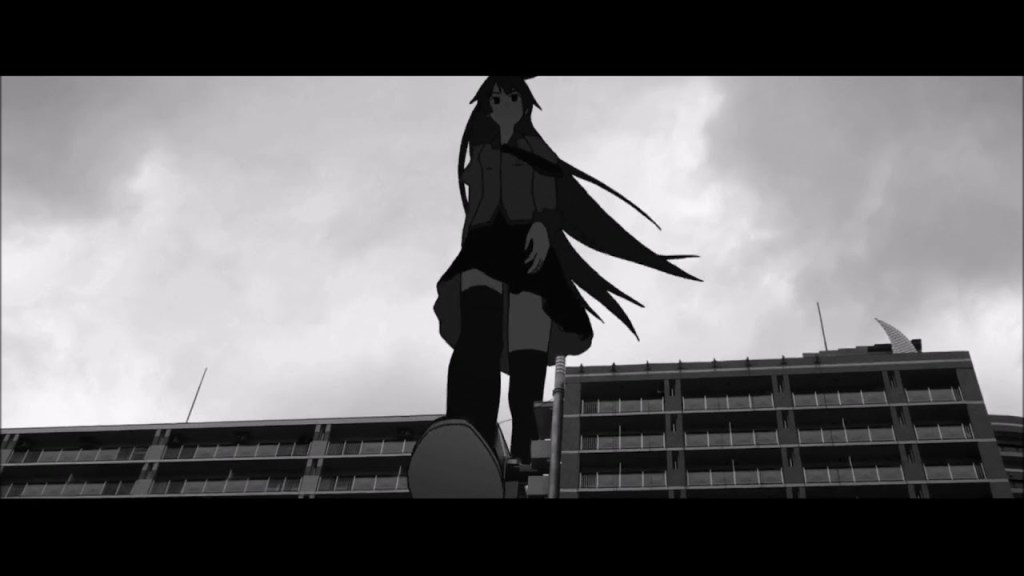
Another unique aspect of Monogatari is its collection of vibrant, eclectic opening sequences. While most anime typically have one opening per season (around 12-13 episodes), Monogatari entries have a new opening sequence for each individual arc. The song itself in these unique animations is performed in character by the voice actor of the given arc’s protagonist. In Bakemonogatari, this begins with Chiwa Saitou singing as Senjougahara in the song “stable staple,” the opening for the “Hitagi Crab” arc in episodes one and two. In home media releases, episode 11 features the opening song “Sugar Sweet Nightmare” by Hanekawa’s voice actor Yui Horie. This makes sense; technically all five of these remaining episodes make up the “Tsubasa Cat” arc, and the same song plays for episodes 13-15, which depicts the bulk of that arc’s actual plot. However, despite the arc being named for another character, episode 12 features “stable staple” again, immediately conveying the importance of Senjougahara to this particular episode. This is one of the few times this creative choice is made throughout the entire franchise. However, in the original broadcast version of Bakemonogatari, “stable staple” is actually the opening used for every episode that revolves around Araragi’s feelings for Senjougahara in some profound way. For example, in the original broadcast of episodes six and seven, the first two parts of the “Suruga Monkey” arc, “stable staple” was used instead. The same is true for the original broadcast version of episode 11, where Hanekawa probes Araragi about his relationship with Senjougahara. The overwhelming frequency of “stable staple” being used indicates the true focus of Bakemonogatari as a whole: despite the arcs seemingly being about other characters, everything actually comes back to Senjougahara, to Araragi’s evolving bond with her.
When Araragi arrives at Senjougahara’s home, he realizes he will soon face a fear shared by many young people in new relationships: their driver for the evening will be none other than Hitagi’s father. Throughout the drive, Araragi fidgets in the backseat, anxiety on display. Hitagi toys with him, asking him questions relating to his feelings and physical attraction to her. If he appears despondent, concerned about her father in the front seat, Hitagi playfully accuses him of not caring for her. At times when he respectfully refers to her as Senjougahara, she informs her father that Araragi has something to say to him. This forces him into a corner that he must use her first name, Hitagi, to get out of, a gesture in Japan that betrays a close intimacy—which normally would not be a problem, were it not for Hitagi’s silent father behind the wheel. Throughout the car ride, Monogatari‘s penchant for depicting close point-of-view comes into play. As usual, the camera follows Araragi’s perspective, frequently cutting from close-ups of Hitagi to her father’s side profile, the glimpse of his reflection in the rearview mirror. This creative technique easily conveys Araragi’s nerves, his tendency to glance up to the Senjougahara father when the daughter says something particularly provocative. Occasionally, while Hitagi grills and teases Araragi, her fingers crawl over his thighs, toying with him in an attempt to arouse and further embarrass him. However, when Araragi blinks, Hitagi is across the backseat from him, her hands kept to herself. This is one of the best examples of Monogatari‘s use of perspective and unreliable narration; it is unclear what is actually happening and what is simply Araragi’s hormonal imagination.
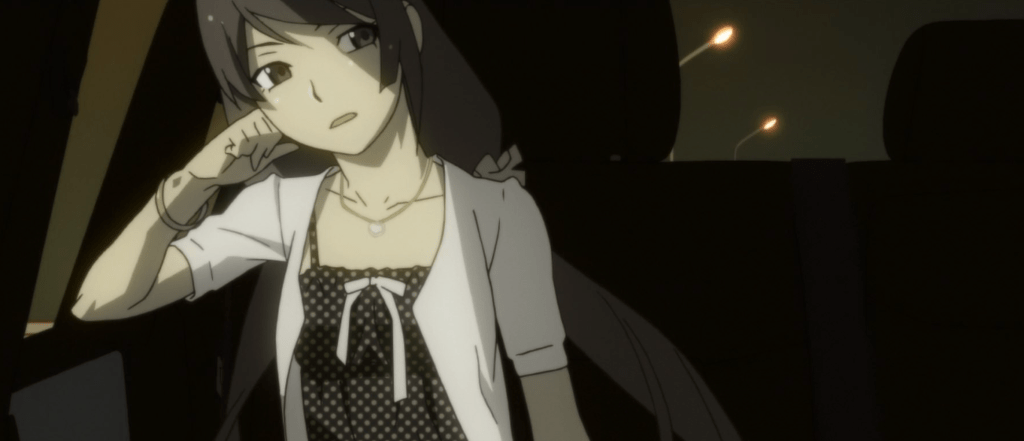
As they arrive at their destination, Hitagi forces Araragi to remain with her father, leaving them alone in a tense silence as she scouts out the location of their date ahead. Before the situation has a chance to grow too uncomfortable, Mr. Senjougahara bluntly asks Araragi to take care of his daughter, jokes about how dramatic the request is, and then details his thoughts about the young couple’s relationship. He expresses deep regret over how much of Hitagi’s childhood he missed out on by being a self-described “workaholic,” and he confesses the grave concern he had for years over her health, her missing weight, her missing emotions. He says that he would jump at any opportunity to help his daughter, though she never asks for anything—until today, when she looked past the years of hurt feelings to ask her father to drive her and Araragi to their date. Ever since Hitagi’s meeting with Araragi, Mr. Senjougahara has noticed her opening up slowly, a trickle rather than a downpour. With Araragi’s influence, Hitagi is gaining new friendships, expressing passion for her future, and gradually shedding her old callousness and replacing it with something kinder. Ultimately, Hitagi’s father gives Araragi his immense gratitude, thanking him for saving Hitagi’s life.
“Hitagi saved herself,” Araragi says in response to this, characteristically downplaying his own role in her recovery. “I was just there.”
“That is all she needed,” her father says. And this highlights one of the truly good things about Araragi, one he does not often credit himself with. Although many times the people he helps end up finding their own agency and taking matters into their own hands to solve their own problems, Araragi is always by their side, steadfast in his support. This resolute presence, more than anything else, is what Hitagi needed to save herself. Although students and teachers who are not really familiar with Hitagi’s relationship are often skeptical of Araragi’s place in it, those close to the couple have a much more ingenuous and optimistic opinion of it. They are capable of seeing how good Araragi is for Hitagi, and vice versa. While, for instance, outside observers may think Araragi makes more sense with someone like Hanekawa, people like Hitagi’s father and Hanekawa herself understand the relationship, that it is helping both Hitagi and Araragi improve as people in order to make it work. Both are changing, that is true; though the change is only for the better.
Hitagi returns to the car and leads Araragi through a forest, leaving her father to keep himself occupied. As they proceed through the woods, Hitagi forbids Araragi from seeing anything by holding his head down, carefully guiding him to a mysterious area and then having him lie on his back. Despite this bizarre secrecy, Araragi smiles, something he doesn’t do often. When she does allow him to open his eyes, Araragi sees an array of stars, glowing constellations spread across a clear stretch of sky. Hitagi has led him to a clearing, lying him on a blanket she spread in the grass. She lies beside him, gauging his reaction to this unusual sight, so far outside of the city. As Hitagi points out and names the various constellations above them, Koyomi is lulled into his own memory, seeing key moments from their relationship: Hitagi falling from the top of the great spiral staircase when they met, Hitagi confidently confessing her love to him after they helped Hachikuji. As he relives their relationship, he smiles to himself again.
“That’s all,” Hitagi says, tugging Koyomi from his own thoughts.
“What do you mean?”
Hitagi lays herself bare, spelling out what she views are her essential components, the parts that make up the very essence of her, though they are all largely symbolic: her ability to help him study, her quiet father and boisterous underclassman Kanbaru, the sky that twinkles above them. Until this point in the story Hitagi has opened up little by little, but this is when she lets her true self flood forth. “This is all I have,” she says.”This is all I can give you. This is everything.” Hitagi continues to let her real thoughts and feelings pour, expressing complete vulnerability. She comments on their often aggressive rapport, and she offers Koyomi her body.
But here Hitagi cuts to the truth of her overt sexuality, confessing that she fears to actually be physically involved with Koyomi. There is a compelling and complex contrast between Hitagi’s gradually developed emotional vulnerability and her inability to be sexually vulnerable. It rings true for many people in relationships, that despite growing and slowly becoming more open to your partner, various traumas and past pains may leave some elements of a relationship closed off to you still. Hitagi associates sex with her past assault, and she is afraid that doing this with Koyomi will lead her to loathe him, that such loathing will drive him away in the end. This is the hardest truth of all, and makes all “fan service” involving Senjougahara earlier in the series make perfect sense; it is her coping mechanism, her attempt to take ownership of her trauma, despite the lingering fear of her body and potentially having sex with others. This serious and complex exploration of sexual trauma is often avoided in media, particularly in the medium of anime, where sex is so often used exclusively as a punchline. And instead of struggling for the right words, searching for some cool thing to say, Koyomi responds honestly, in the best way he possibly could: silently, he simply takes Hitagi’s hand.
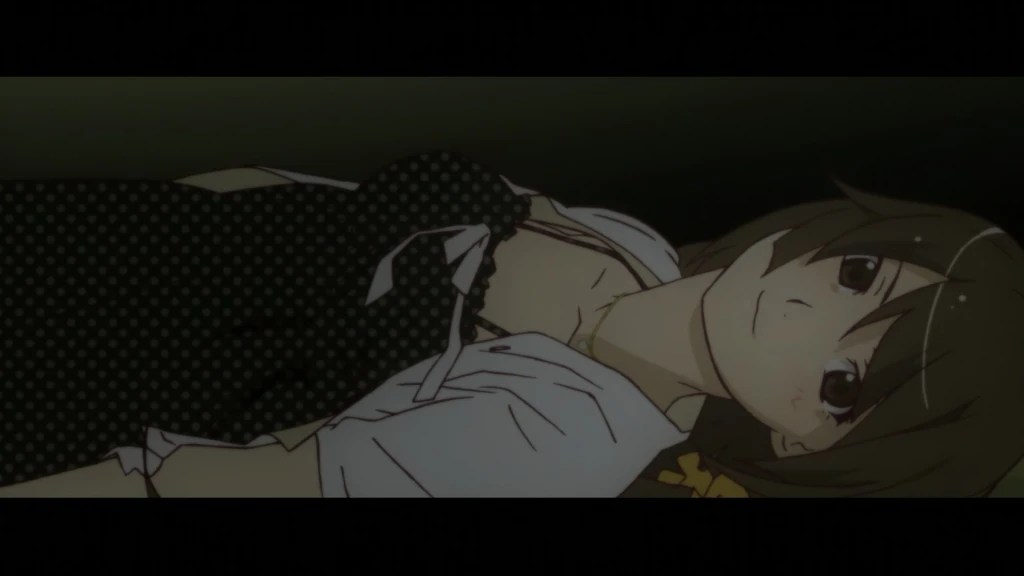
After a quiet moment watching the stars, Hitagi mentions her history of misfortune. But, she says, all of her suffering was worth it if it eventually led to this moment, lying still under the sky hand-in-hand with Koyomi. While she says she will try to make the physical element of their relationship work eventually, she offers this moment together in lieu of that, nothing but the two of them and a glowing field of stars. This place is of the utmost significance to her, she explains. Long ago, when her parents were happy, when Hitagi had yet to suffer an ounce, they brought her here. It harkens back to one of the only truly happy moments she can remember. It is her treasure, and now she wants it to be theirs. Having offered everything to him, Hitagi asks Koyomi if she loves him.
“I love you,” he says, quickly, honestly. The Hitagi Senjougahara before him is a far cry from the girl he first met, her every action veiled in a defensive hostility, the girl who once wished to never be emotionally exposed enough to be able to feel pain again. Now she expresses her deepest secrets freely with the one she loves, wanting nothing more than the emotional vulnerability she once fled from. Over the course of Bakemonogatari, Hitagi has grown into someone who is open to life and its varying emotions, willing to risk potential in order to experience moments like this with Koyomi.
“What do you love about me?” Her question carries none of the playful, sarcastic tone she usually has when interrogating him. She has just attempted to break herself into pieces for him to inspect, to decide what he likes and does not.
“Everything,” he says. “There is nothing about you I don’t love.” And when he asks her the same question, she responds in kind, praising the qualities he so often dismisses or ignores: his kindness, his looks, the way he would drop everything to rescue her at a moment’s notice. And while Hitagi isn’t ready to have a sexual relationship with Koyomi, she is ready to at least try something: she asks Koyomi to kiss her, something that neither has ever done. The final moments of the episode depict both Hitagi and Koyomi turning to each other, earnest smiles spreading across their faces. Then the camera pans up to the sky, Bakemonogatari‘s ending song beginning to play. While it plays for every episode, it takes until episode 12 for the lyrics to make sense. The song’s lyrics detail the many starry constellations, with the vocalist, now clearly singing from the perspective of Senjougahara, spiraling into a love song about being vulnerable and opening up. This song in itself is another clear sign of Bakemonogatari‘s heart, that fully realized relationship between its two leads. While there are many major characters throughout the series, everything from the show’s music to its emotional climax signal that it has and will always really be about Hitagi Senjougahara, Koyomi Araragi, and the relationship that leaves them both completely seen and fulfilled.
Episode 12 of Bakemonogatari is an unparalleled showcase of emotional character writing, a masterpiece that caps the series’s original broadcast off and raises it into being one of the greatest works in the medium. There are few stories that better depict characters finding love and growing as individuals to bolster that love, rather than some inherent flaws tearing the relationship apart. Although the final three online-only episodes wrap up the story and contain their own emotional catharsis for Araragi, Bakemonogatari‘s true, beautiful, and lovely emotional climax is episode 12 and the date it depicts.
Tsubasa Cat
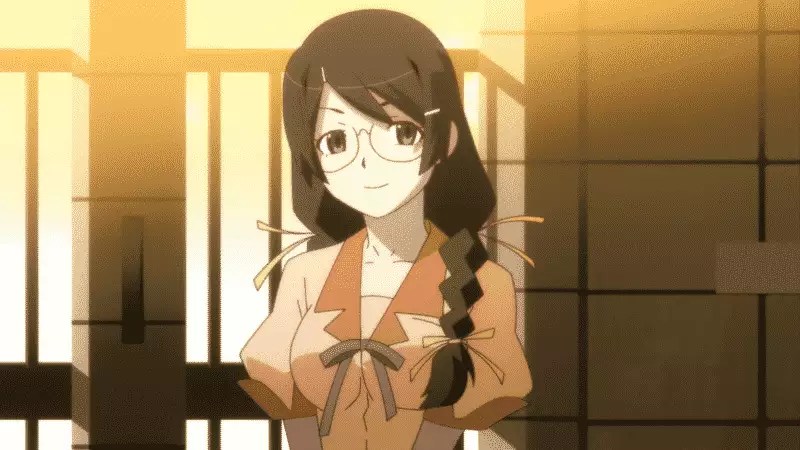
There is an obvious change in Araragi at the beginning of episode 13: as he walks to school, he sports a huge smile, his thoughts swimming with his recent date and subsequent first kiss. This is the most outwardly happy that viewers see Araragi in Bakemonogatari, a clear sign of Senjougahara’s positive effect on his state of mind. He encounters Hachikuji on his walk, and he listens to her report that she has seen Shinobu, the vampire child Araragi shares a mysterious bond with, wandering outside of the city, gazing intently through the windows of a local donut shop. Araragi dismisses this immediately; after all, Shinobu is unable to wander freely, trapped under the supposedly watchful gaze of Meme Oshino.
The final few episodes feature the return of Tsubasa Hanekawa’s resident apparition, the catlike curse that takes possession of her body in times of great stress. The earliest stretch of the arc focuses on Araragi investigating what caused the apparition’s resurgence, as it was brought about before by Hanekawa’s fraught relationship with her parents. However, Araragi’s attention is divided by a sudden new problem: Shinobu, much like Hachikuji informed him earlier that day, has vanished. Her caretaker, Oshino, has no answers for how this happened, answering Araragi’s questions with vague riddles and amused apathy.
Araragi partners with Oshino to subdue the rogue “Black Hanekawa,” a label they use when she is under the possession of the cat apparition. Oshino binds Black Hanekawa to the roof of the abandoned cram school that he uses as his base. Araragi returns to his high school, still intent on succeeding in his studies so that he may accompany Senjougahara to college and experience a future at her side. When he returns to the cram school that afternoon, however, he discovers that Black Hanekawa has escaped, despite Oshino’s alleged supervision. Frustrated, Araragi bickers with his mentor, but his jabs are met only with Oshino’s trademark grin, the lopsided cigarette hanging from within it. As Araragi realizes he will get no help from Oshino with either of the missing apparitions, he flees via bicycle in exasperation. Oshino calls out to him from the roof of the school, waving an aloof farewell. Araragi thinks nothing of it and sets off to, for once, handle things without the guidance of the strange man who has taught him everything he knows.
While the Araragi from the beginning of Bakemonogatari would likely never ask others for help, it is here viewers see just how much he has grown over the course of the series. He reaches out to the girls he has helped with their own supernatural issues: Kanbaru, Nadeko, Hachikuji. They all agree to search for Shinobu on his behalf, scouring the city for any sign of the blonde vampire. Finally, Araragi calls his girlfriend, Senjougahara. He asks her to help him find Hanekawa, but she turns him down; before succumbing to the cat apparition, Hanekawa had enough clarity of mind to ask Hitagi to cover for her at school, leading the planning of an upcoming festival. As they confer, the couple showcase their newfound ability to work in tandem, each filling complementary roles. Senjougahara will fill the void Hanekawa leaves behind as class president, ensuring that her absence does not negatively impact the world she left behind to sort out her apparition-related issues. Araragi will track down Black Hanekawa, utilizing the skills he developed under Oshino’s tutelage to hopefully absolve her of the affliction once and for all. This cooperative strategizing and harmonious teamwork is the satisfying fulfillment of what was promised at the end of “Mayoi Snail,” when Araragi and Senjougahara promised to always be truthful and work together to solve problems. This agreement highlights just how far they have grown, both as individuals and as a couple. Though personal progress is a perpetual process, Araragi and Senjougahara have worked through enough insecurities and emotional roadblocks to function as a couple. After the call, Araragi waits for a moment, perhaps moved by this very realization settling over him. Then he heads out to find Hanekawa.
When he does track her down, Araragi soon discovers the source of Hanekawa’s stress: himself, or at least his relationship with Senjougahara. Black Hanekawa reveals her host’s feelings for Araragi, detailing a love that developed back when Hanekawa helped him deal with Shinobu in his first brush with the supernatural. Araragi has been indirectly causing Hanekawa immense pain throughout Bakemonogatari, confiding in her about his burgeoning relationship without knowing that each comment was driving daggers into her heart. The cat apparition tells Araragi that the only way to eliminate her is for Araragi to leave the happiness he has found with Senjougahara and begin dating Hanekawa instead. This raises an interesting moral dilemma for Araragi, one that harkens back to the character traits that so many of these apparition cases ultimately boil down to. Black Hanekawa is essentially asking him to ignore his own desires and practice self-sacrifice, something he has so willingly done in many of his previous encounters with apparitions in order to resolve them. This choice harkens back to the many times others have wondered why Araragi wasn’t dating Hanekawa instead of Senjougahara, questioning the unique bond that only he and Hitagi understand. And the Araragi at the beginning of Bakemonogatari might relent to Black Hanekawa’s demand, might throw away what makes him happy, his relationship, in order to satisfy someone else.
However, the Araragi standing before Black Hanekawa is one who has learned a difficult lesson for those prone to self-doubt and self-loathing, those who will throw away their own lives if it means bettering the life of another, especially a friend he values like Hanekawa. He has learned that sometimes it is okay to choose yourself, that some things are too vital to throw away. So he does choose himself, for the first time ever. He rejects Black Hanekawa’s ultimatum, choosing to remain with the girl who is as odd as he is, who plans for a future with him at her side, who makes him see the good in himself. All along, Bakemonogatari has been brilliantly building to this emotional climax, the dramatic choice Araragi must make between two ways of life. He could continue how he has been, operating with no agency or self-importance, apathetic to any potential toll on his own life. But he chooses to evolve, to live for the future he and Senjougahara envision together, one of growth, cooperation, contentment. In doing this, he finally acknowledges that he is not to blame for someone else’s problem. Although he is at the heart of Hanekawa’s emotional issues, it is through no fault of his own.

As he explains his decision, the narrative’s use of close perspective comes back into play. While Araragi speaks, his mind drifts to Senjougahara, the camera cutting to shots of her working diligently in Hanekawa’s absence. While Senjougahara was introduced brandishing school supplies as weapons in an aggressive self-defense, now she uses them for their intended purpose, constructing decorations for their class’s contribution to the upcoming school festival. This is a subtle but poignant way to remind viewers of their own growth, to show that her role in Araragi’s life inspires him to finally make decisions that are better for his own life.
Araragi rebuffs Black Hanekawa with the knowledge that he, for once, has no fallback plan. There is no Oshino to appear with a sudden rescue, no Shinobu to sap the apparition’s energy like she did during their Golden Week foray. Black Hanekawa deduces that, if Araragi won’t agree to leave Senjougahara, the only way for her to eliminate Hanekawa’s burden is to kill him. So she falls on him, overpowering him with ease, beginning to dismember him. Araragi initially relents, much in the same way he once did when the possessed Kanbaru disemboweled him. However, as he closes his eyes, he sees Senjougahara, the key moments in their relationship that have inspired him to develop as a person, to live a life that makes him happy. With her face in his mind, he chooses to live, fighting back in whatever weak way he can. When he fails to hold off Black Hanekawa’s rage, Araragi shouts out for help in a way he has never done before, setting his pride aside for a future at Hitagi’s side.
“Help me, Shinobu!” he shouts, calling for the missing vampire. And Shinobu appears, rising from his shadow, where she has apparently been hiding for this very purpose. She proves in a burst of might why vampires sit comfortably at the top of the apparition food chain, easily defeating Black Hanekawa and draining her of energy. In the cat apparition’s place is the normal Hanekawa, unconscious, again amnesiac to the events of her possession.
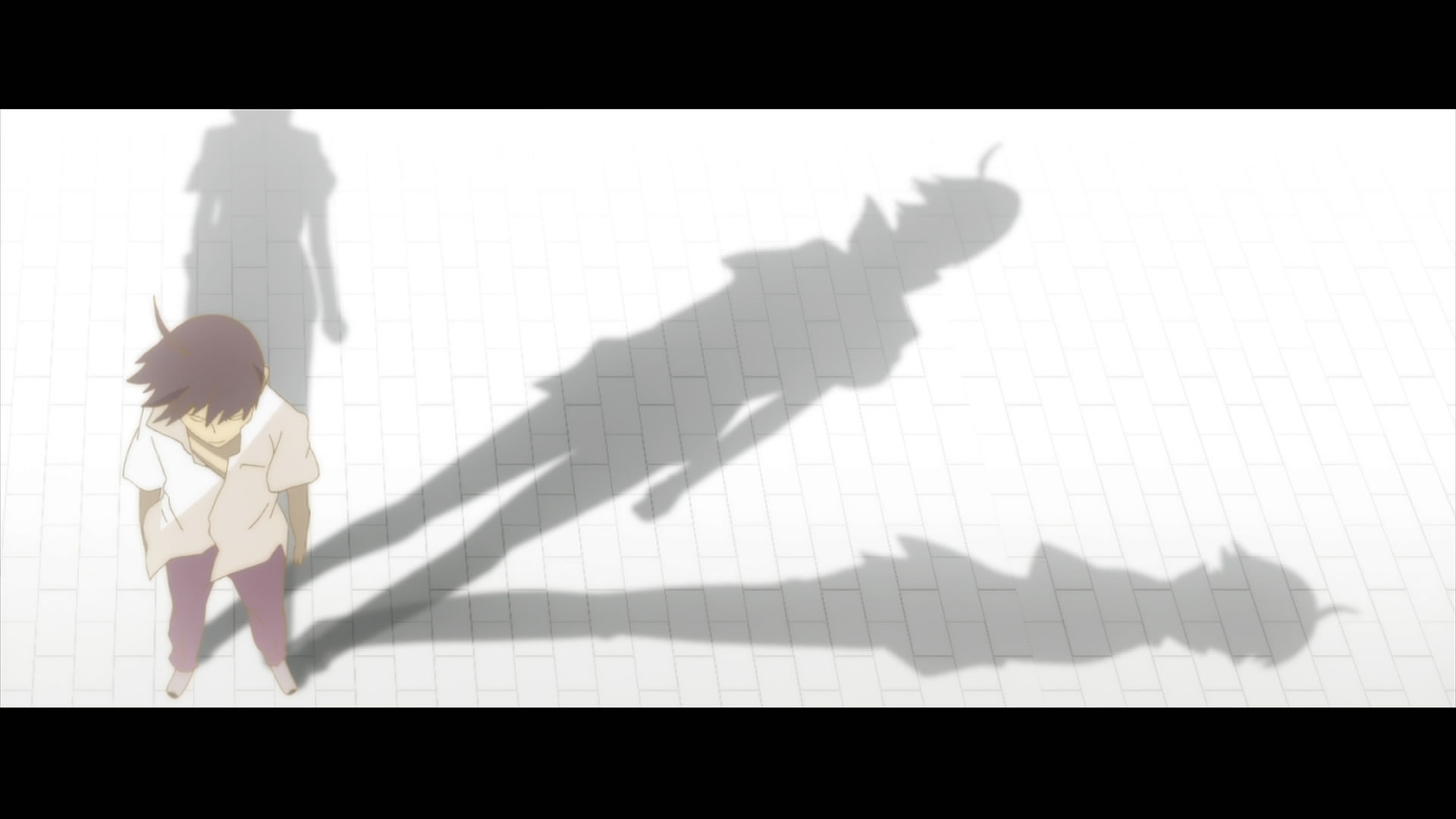
With another oddity resolved, Araragi returns to his normal life. He walks hand-in-hand with Hitagi, filling her in on the battle with Black Hanekawa. Now that the dust has settled, he squeezes her hand and promises her that on their next date, he will show her what he considers his own treasure. This important moment signifies how far he has grown; with his doubt behind him, he can open himself fully to Hitagi, much in the same way she presented her heart to him at the end of their recent first date. However, he soon discovers that Meme Oshino has vanished; the odd wave he gave Araragi from the cram school’s rooftop was seemingly a permanent goodbye. Araragi again enlists the aid of the girls he has helped throughout Bakemonogatari, a clear display that, although he loathes it about himself, his compulsion to help others has an overwhelmingly positive effect on the lives of those around him. His innate need to save others is what forms the very bonds viewers see as the group looks for clues to explain Oshino’s disappearance; it is also visible during Araragi’s confrontation with Black Hanekawa, in flashes of the girls searching the city for the missing Shinobu. While Araragi was always depicted as being alone at the beginning of Bakemonogatari, he is now surrounded by friends, encountering them and engaging in lengthy conversations on his way to and from school each day.
Meme Oshino actually plays one of the most overt and interesting roles in Araragi’s growth throughout the series, filling in as a sort of teacher. In the early apparition cases, Araragi relies on Oshino to essentially guide both he and the victim to a solution. This is seen most clearly when Oshino prepares and leads the ritual to rid Senjougahara of the Heavy Stone Crab, or when he directly tells the young couple how to resolve Hachikuji’s ghostly goal. Then Oshino gives Araragi the chance to solve Kanbaru’s affliction himself, allowing the teenager to take on the Rainy Devil in single combat. However, knowing his student would fail to defeat the apparition, Oshino calls Senjougahara, ensuring Araragi would ultimately be safe and even learn a lesson from his heedless self-sacrificial tendencies. Oshino then allowed Araragi to solve Nadeko’s snake curse with Kanbaru’s assistance, only offering verbal advice and remaining hands-off. As Bakemonogatari progresses, Oshino grants Araragi agency little by little, culminating in the final conflict within “Tsubasa Cat.” With Oshino’s disappearance, Araragi can see his mentor’s role in things clearly: Oshino freed both Shinobu and Hanekawa himself, providing Araragi with one final “test” that he was sure his student would successfully pass. Oshino’s wave from the cram school’s rooftop was effectively a passing of the torch; he is satisfied with Araragi’s growth, both as a person and as a resolver of apparitions. He can entrust Araragi to look after the city on his own. Oshino’s home base being a cram school is the most obvious symbol of his vital role in Araragi’s life.
During his final confrontation with Black Hanekawa, the cat apparition told Araragi that if he chooses to rescue everyone, no one will be special. She calls into question his relationship with Senjougahara, wondering what could possibly set her apart from the other girls Araragi has saved throughout the series. As Araragi calls off the search for Oshino, he and the girls mosey back into the city, chatting together as a group. However, as the girls each depart from the gathering, Koyomi Araragi is left alone with the one who matters most to him: Hitagi Senjougahara, who rides away with Koyomi on the back of his bicycle, an arm wrapped around his waist, her head leaned against him. In the end, Black Hanekawa was wrong about the nature of Araragi’s relationships; although he has formed special bonds with each of the girls, none of them compare to his connection with Senjougahara, his special one. They are two people drawn together by their many similarities, stark differences, painful pasts, and hopes for the future. This moment of solace is repeated many times throughout the greater Monogatari franchise; at the end of many of the series’s story arcs, Koyomi returns from some final skirmish to Hitagi, who is always waiting with a knowing smile, with open arms.Bakemonogatari is a difficult series to define. An argument can be made that it fits many different genres: there are certainly elements of horror, of mystery. However, the most fitting label has to be romance, and Bakemonogatari is one of the finest in the genre. Under the layers of supernatural violence and monster possessions, the core of the series revolves around two people finding love and working to improve themselves in order to allow that love to blossom and breathe. With Araragi and Senjougahara, original creator Nisio Isin and studio Shaft present a love story that rises above its medium, one that presents two flawed, fully-realized characters and a bond from which viewers can learn the importance of self-improvement—not only for oneself but for the health of their relationships. At its heart, Bakemonogatari teaches its audience how to choose themselves, how to open up to others, how to love fully.
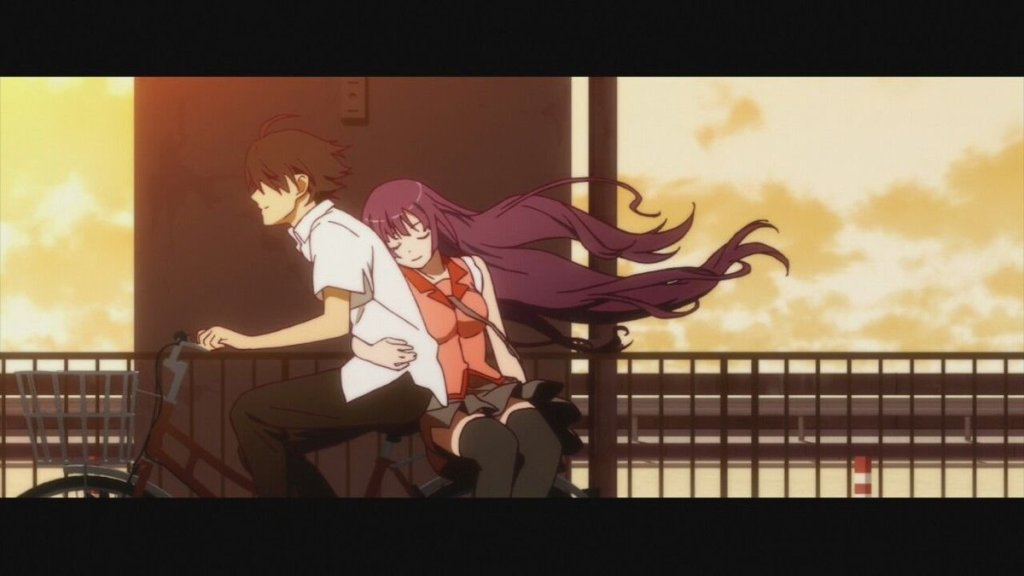








































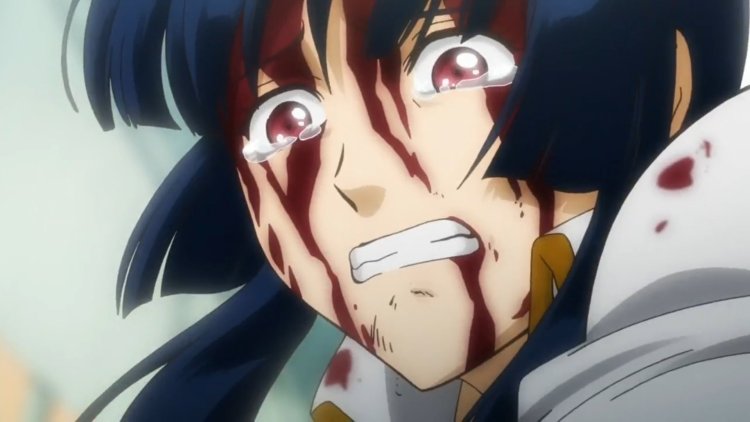

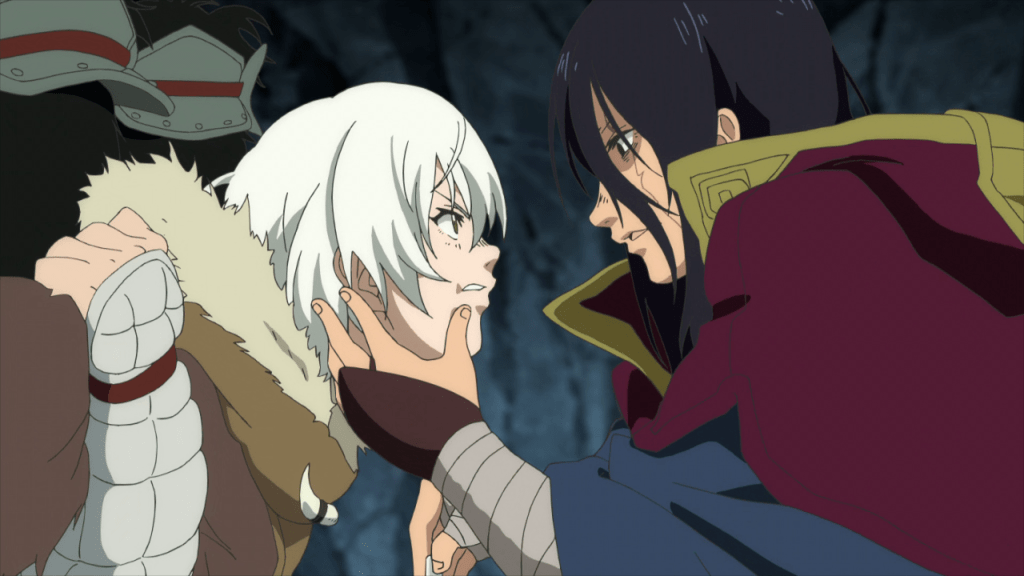




















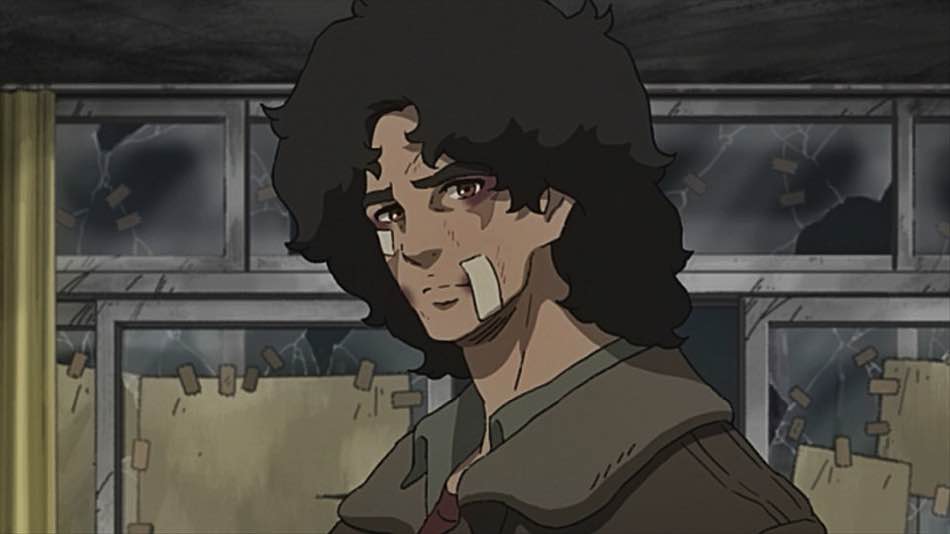

 Red Comet Reviews