
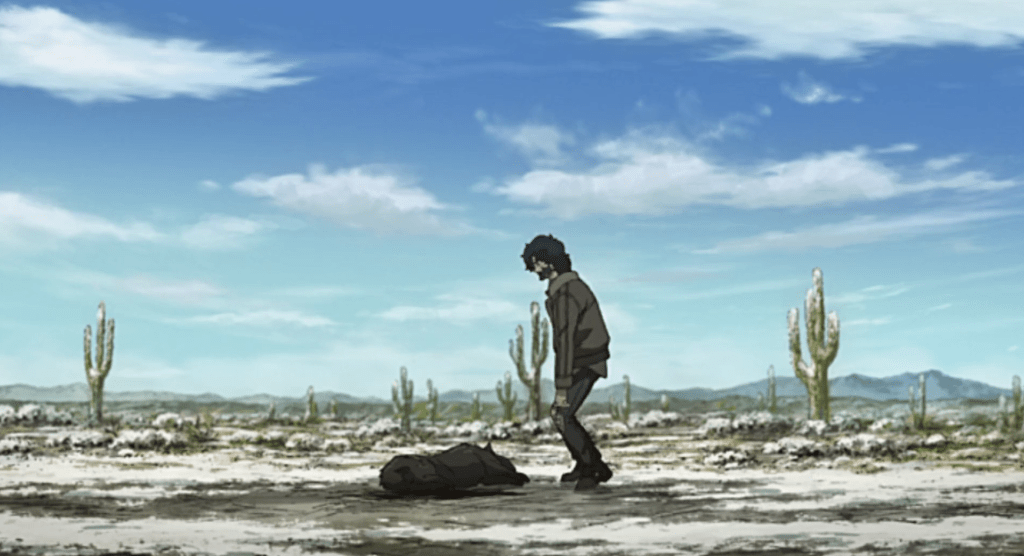
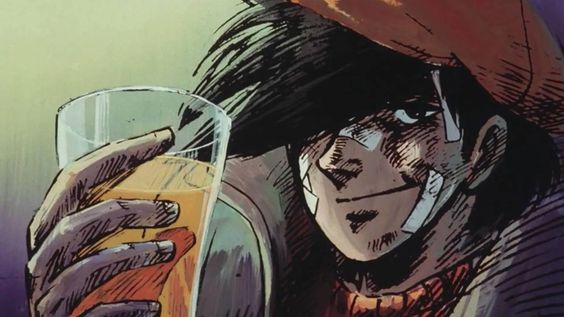
The follow-up to 2018’s Megalo Box, a loose adaptation of historic manga Ashita no Joe, hits like a truck. The first season of the show is thoroughly enjoyable. While it follows a wild protagonist’s standard underdog journey from slums to world champion, the production elements and weaponized nostalgia win audiences over with ease. The ties to the Joe manga are prevalent in the first season, and many of the characters are remixed into new iterations. The events are wholly more optimistic than those of the manga, but that doesn’t mean its dramatic edge is dulled.
Nomad ramps up the narrative stakes tenfold, and it grows much richer thematically. Gone is the fiery-eyed Joe from the first season; seven years later, he now lives as a haggard, scarred boxer who brawls his way through the underground fighting scene. Known only as “Nomad” in these illicit arenas, the older Joe has become everything he once rallied against. For one, Nomad uses mechanical enhancements in these back-alley fights; he embodies the antithesis of “Gearless Joe,” the scrappy young man who used his own body against the corporation sponsored professional boxers who earned their titles through cybernetic advancement. The Nomad has hardened his heart, lost the compassion that made him such a likable lone wolf in the first season.
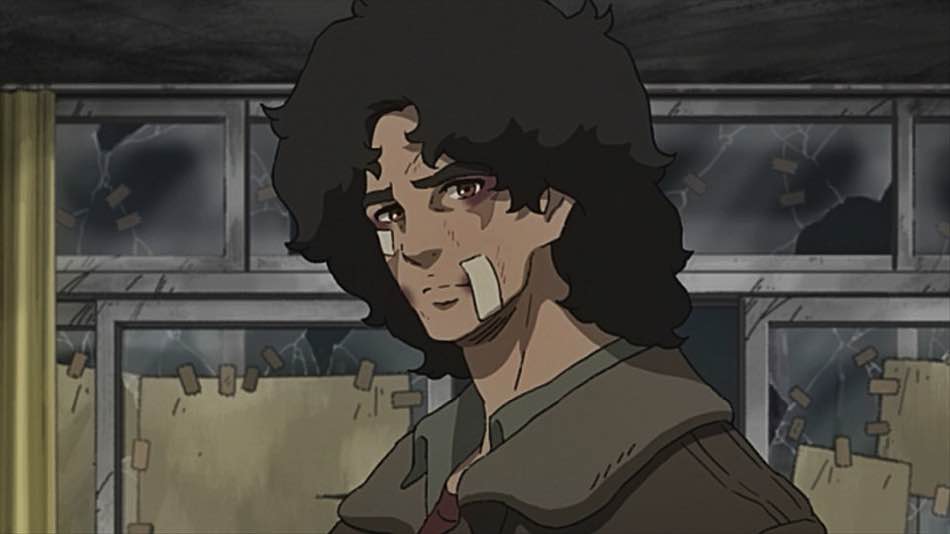
His found family established in Megalo Box are notably absent. Joe’s coach Nanbu and the orphan children they jointly cared for have all vanished. The tale of how Joe lost his loved ones is presented in haunting glimpses of the seven years before Nomad, and the writers’ ability to strategically reveal information in flashes throughout the season is a compelling one. It isn’t until late in the story that viewers have a full picture of what really happened to Joe between Megalo Box and Nomad, but giving the audience the ability to piece together Joe’s past on their own is a highly effective narrative choice.
Joe begins the process of self-discovery again while assimilating with an immigrant community, fully engaging with their lifestyle and culture. Battling a brutal addiction and fear of returning home, this Joe is for the first time unbelievably human. His many plights and anxieties help the audience latch onto him, and I was moved to tears by his journey several times. The strongest part of Ashita no Joe‘s story is arguably its reliance on character depth; the manga’s Joe Yabuki is examined in great detail, entire panels dedicated to his melancholic gaze. Both Joe and Nomad feature boxing protagonists, but the stories are more about who that character is rather than the foes they punch out. The original manga muses about the concept of identity, of finding yourself in what you love. When the passions that define you are taken away, what’s left? Ashita no Joe and Nomad reach different answers to this question. Joe Yabuki lives and dies to throw punches, for the animalistic thrill of putting his being on the line. Nomad‘s Joe begins this particular journey in a similar way, but regret and loss build him into an entirely different man than his predecessor in Ikki Kajiwara’s manga. The oppressive gloom from the beginning of the season eventually gives way to gentleness as Joe determines what is more important to him than fighting, and the story’s optimistic trajectory is a welcome change from Ashita no Joe‘s original grim conclusion.
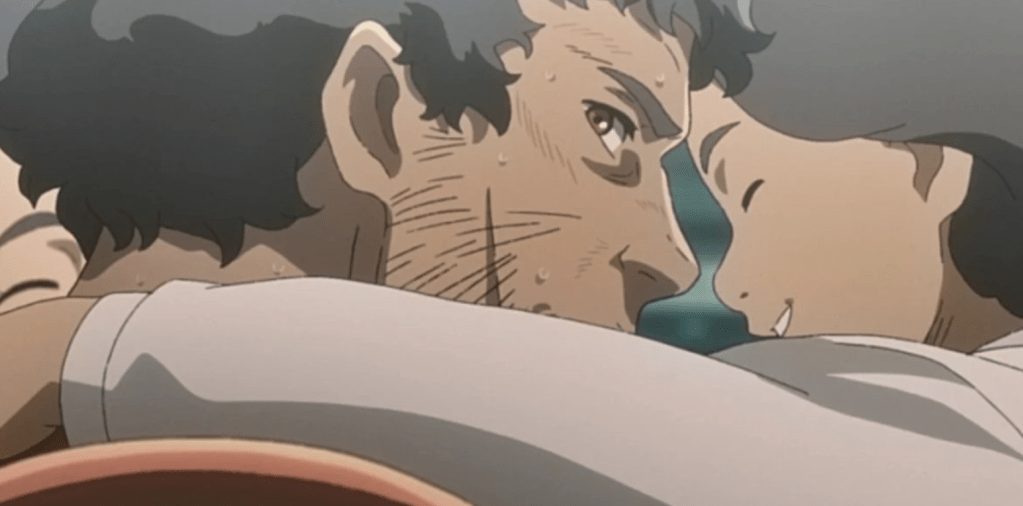
Fans of boxing stories both good and bad have grown accustomed to the protagonist’s opponents being one-note caricatures who exist for the sole purpose of being knocked down. Nomad rises above this trope with finesse. Following in the vein of Megalo Box‘s Yuri, Joe’s three major rivals in Nomad are as fleshed out as he is, each with sympathetic motivations and beautiful arcs that play out alongside Joe’s own. The first arc of Nomad revolves around Joe’s relationship with Chief, a leader of the immigrant community he takes temporary shelter with. Chief is everything “Nomad” Joe isn’t: positive, selfless, and charismatic. He pushes Joe to be the best he can, encourages him to accept his faults and move forward with rectifying them. Their friendship becomes the soul of the story, and it fuels the narrative with an emotional weight that lasts through its conclusion. Chief teaches Joe the importance of empathy and the shortness of life. Liu is a boxing prodigy, the student of Joe’s former rival Yuri. He replaces Joe in the court of public opinion and becomes a stand-in for the Joe of years past: quick, ardent, and likable. Mac, Joe’s last opponent, is a family man who arguably becomes the protagonist of the anime’s final act. The gravitas the show gives his arc is resonant, and it’s impossible to not sympathize with him after receiving an intimate portrait of his family life and the way mega-corporations have ruined his body. Mac most clearly mirrors the aging Joe, and the depths explored in each of these characters makes it hard to choose who to root for in their final bout.
Nomad is about many things: aging, loss, legacy, forgiveness, redemption. We see Joe’s body aging, his reignition of compassion. Joe struggles to honor the legacy of his mentor, to set a good example for Sachio, the orphan who is akin to his son or younger brother. The relationships in Nomad are messy, imperfect, and universal. Joe’s physical and mental journey back home can be both difficult and endearing to watch, but its execution is a thing of beauty.
Nomad was made with great care, delicately crafted to feature an intimate story and the same production tricks that make a 2021 series feel antiquated in a good way. Although there are fewer boxing matches than in its first season, each fight is meticulously animated to help viewers feel the impact of each blow and maintain the suspense of who will emerge triumphant. The show’s soundtrack remains one of its best elements, and the music present may be even better than the fantastic rock score Megalo Box boasted. The iconic themes are still present, but they now intermingle with Spanish-inspired guitar riffs and contemplative instrumentals. The music is varied and always appropriate for the unfolding story beats. Each central character has their own original theme music, and most of these tracks feature alternative versions to match the context of the scenes. The entire score is composed by mabanua, whose score punctuated the bombastic first season. Although the new music is outstanding, Joe’s original theme is still immensely memorable. When it finally shows itself in a key moment late in Nomad, it’s difficult to not feel the thrill of the upcoming dramatic action.
Nomad is a sequel that takes its first entry and flips it on its head. Who knew the perfect follow-up to an underdog boxing story would be an introspective road to recovery, a serious tale of family and transience. Joe’s last adventure is, without a doubt, my favorite anime of the year.

 Red Comet Reviews
This is written really well 🙂 Might give it a watch sometime!
LikeLiked by 1 person
My favourite anime of 2021
LikeLike